Quad 2-input NAND gate for wide-voltage and harsh-environment designs
It operates across a 3V to 18V supply range, making it suitable for battery-powered equipment, industrial control systems, and automotive electronics that must tolerate unregulated or fluctuating rails.
The 3V to 18V supply range is the first thing to check when replacing a 74HC or 74LV gate. The CD4011UBM96 works directly on a 12V or 15V industrial bus without a regulator, whereas the SN74LV00APWR tops out at 5.5V. The trade-off is speed: at 15V and 50 pF load, propagation delay is 50 ns, roughly seven times slower than the 7.5 ns of the 5V-only 74LV family. If the adjacent logic runs at 3.3V, expect longer delays — the 4000B family slows as supply drops. For a glue-logic path that does not need fast clock rates, the wider voltage tolerance simplifies the power tree.
Quiescent current and temperature range
Maximum quiescent current is 1 µA across the full supply range and temperature span. In an always-on sensor node or a wake-up circuit where every microamp matters, this gate adds negligible overhead.
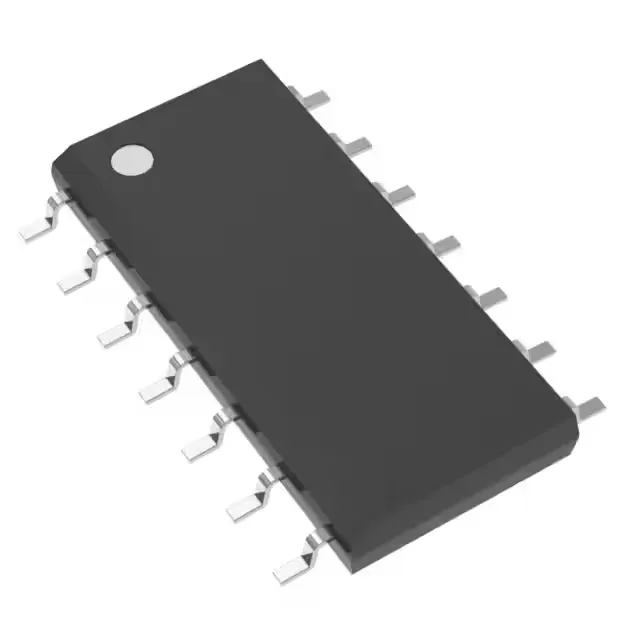
Supplied in a 14-SOIC package with 3.90 mm body width (0.154 inch). The footprint is standard SOIC-14, shared with countless other logic and interface ICs, so no board respin is needed if you swap between 4000B, 74HC, or 74HCT parts in the same package.
For dual-sourcing resilience, note that the CD4025BM96 is a triple 3-input NOR gate in the same 4000B family and same 14-SOIC package — not a pin-for-pin replacement, but a functional alternative if the logic function can be redesigned.