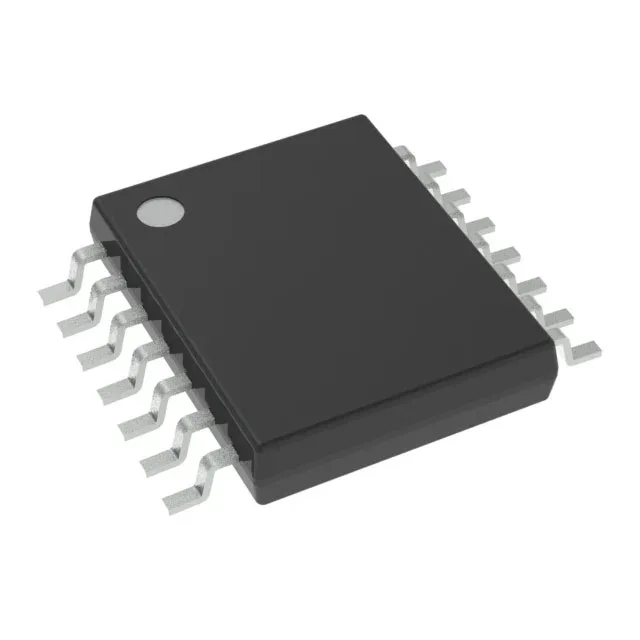
CD4011BPWR

Texas Instruments · 4000B Series

Texas Instruments 4000B series CD4011BPWR quad 2-input NAND gate, 3 V to 18 V supply, 1 µA max quiescent current, 90 ns propagation delay at 15 V/50 pF, 14-TSSOP package, -55 to 125 °C operating temperature.

Texas Instruments CD4011BPWR
Download datasheet (PDF)
[IN STOCK] In Stock: 4,337 pcs
$0.47/ pc

Volume pricing

Buy Now

Subtotal:$2.35

MOQ 5 · Tape & Reel (TR); Cut Tape (CT) · RoHS · EIA-481 · DAP/DDP · T/T

Technical specifications

CD4011BPWR specifications
Parameter / AttributeSpecification / Value
Series4000B
Logic typeNAND Gate
MountingSurface Mount
Supply voltage3V ~ 18V
Current - quiescent1 µA
Current - output high, low3.4mA, 3.4mA
I/O channels2
Operating temperature-55°C~125°C
PackageTape & Reel (TR); Cut Tape (CT)
Case14-TSSOP (0.173\", 4.40mm Width)
Number of circuits4
Input logic level - low1.5V ~ 4V
Input logic level - high3.5V ~ 11V
Max propagation delay @ v, max CL90ns @ 15V, 50pF
100% Footprint Match · Solder-Ready (No PCB Redesign Needed)

Need Stock or a Drop-in Second-Source for CD4011BPWR?

Package: DIP-14 / SOIC-14 / TSSOP-14 · Pin-compatible replacements with immediate Shenzhen spot stock

Footprint Match 99%
Supply Chain & Allocation Reality:

The CD4011B is the quad 2-input NAND of the 4000B CMOS generation - the logic of old industrial timers, alarm panels, appliance controls and instrument interlocks that are still in service and still repaired. Inside the 4000B family the pinout is a JEDEC standard, so every manufacturer copy swaps pin-for-pin. Outside the family it is a trap zone: the 74HC00 quad NAND looks like the same function in the same 14-pin body, and it is wired differently, runs on a narrower supply, and drives ten times the current.

Verified Pin-Compatible Replacements (4 verified alternatives)

HEF4011B Nexperia DIP-14 / SOIC-14
100% Drop-in (Zero Code Change)
Availability & Target Pricing:

Pin-for-Pin by JEDEC Standard

Shenzhen Spot Stock (24-48h Dispatch)

Electrical & Core Specs:

The Nexperia 4000B quad NAND: 3V to 15V supply, symmetric output drive, same function table and same folded gate arrangement (gate outputs on pins 3, 4, 10 and 11).

3V to 15V; quiescent current nanoamp class; inputs protected to the rails.

Compatibility & Drop-In Notes: The correct substitution when a 4000B board needs a logic gate. No circuit change: same thresholds, same drive, same speed class for the application.
Package & Solder Footprint: DIP-14 / SOIC-14 with the standard 4000B pin assignment (VDD = 14, VSS = 7).
Shenzhen Warehouse Stock & MOQ: Continuous multi-fab production; DIP parts still widely available for bench repair.
MC14011B onsemi (Motorola line) DIP-14 / SOIC-14
100% Drop-in (Zero Code Change)
Availability & Target Pricing:

The Classical Second Source

Shenzhen Spot Stock (24-48h Dispatch)

Electrical & Core Specs:

The Motorola-line 4000B NAND - the part many of these boards were originally built around. Same pinout, same 3V to 15V window.

3V to 15V, standard 4000B drive (about 0.5mA at 5V rising to 3.4mA at 15V).

Compatibility & Drop-In Notes: Equivalent to the CD4011B in every circuit parameter that matters for legacy repair. The B suffix indicates buffered outputs - keep the B when replacing a B, and note the UB (unbuffered) variants are different parts.
Package & Solder Footprint: Standard 4000B 14-pin arrangement; TAB markings differ, pin geometry does not.
Shenzhen Warehouse Stock & MOQ: Long production heritage; stocked DIP and SOIC.
CD4093B TI / Nexperia / onsemi DIP-14 / SOIC-14
Functional Equivalent
Availability & Target Pricing:

Same Socket, Schmitt Inputs

Shenzhen Spot Stock (24-48h Dispatch)

Electrical & Core Specs:

Same quad 2-input NAND function in the same 4000B pin arrangement, with Schmitt-trigger inputs: each input has defined hysteresis thresholds instead of a single transition point.

3V to 15V, same drive class as the 4011B.

Compatibility & Drop-In Notes: Pin-for-pin with the 4011B, but not behavior-for-behavior: in oscillator and timing circuits tuned around the plain 4011 thresholds, the Schmitt thresholds shift the frequency. In debounce and slow-edge duties it is strictly better. Check which role the gate plays before swapping.
Package & Solder Footprint: Identical 14-pin arrangement (the 4093 shares the 4011 pinout); same DIP/SOIC land patterns.
Shenzhen Warehouse Stock & MOQ: Stocked alongside the 4011 family; commonly bought together for repair kits.
74HC00 Nexperia / TI / onsemi DIP-14 / SOIC-14
Functional Equivalent
Availability & Target Pricing:

Faster and Stronger - But a Different Wiring

Shenzhen Spot Stock (24-48h Dispatch)

Electrical & Core Specs:

The high-speed CMOS quad NAND: 2V to 6V supply, roughly 15ns propagation against 60-90ns for the 4000B part, and about +/-4mA output drive at 4.5V against 0.5mA for the 4011B at 5V.

2V to 6V only - it will not survive the 12V or 15V rails that legacy 4000B boards routinely run.

Compatibility & Drop-In Notes: Listed as the classic cross-family trap: same function, same package, different wiring and different voltage. It is the right modernization when a board is being redesigned for 5V - and the wrong part to press into a 12V legacy socket.
Package & Solder Footprint: A 74HC00 inserted into a CD4011B socket connects inputs to outputs at several pins. Never a straight swap.
Shenzhen Warehouse Stock & MOQ: Universal stock; the correct part when the redesign window exists.
Buyer & Quality Checklist for Sourcing Alternatives
  • Within the 4000B series the pinout is a JEDEC standard - CD4011B, HEF4011B, MC14011B and TC4011BP swap pin-for-pin. Across families (74HC00, 74LS00) nothing but the supply pins stays put.
  • The 4011B drive is small and symmetric: about 0.5mA at 5V, 1.3mA at 10V, 3.4mA at 15V. It drives CMOS inputs happily and LEDs or relays only through a transistor - do not expect HC-class drive.
  • Keep the suffix honest: B parts are buffered, UB parts are unbuffered; they differ in output curves and are not interchangeable in analog-adjacent positions.
  • The 4093 (Schmitt NAND) shares the pinout and improves slow-edge and debounce circuits, but changes oscillator timing. Identify the role of each gate before making the swap a policy.
  • Legacy boards often run the logic at 12V or 15V; check the rail before proposing any 74HC-family modernization - HC parts end at 6V.
  • For repairs, unmarked or re-marked 4011 stock is common; the part is cheap enough that verified lots from documented fabs are the sensible default.
Frequently Asked Technical Questions

Q: Can I replace a CD4011 with a 74HC00?

A: No - same function and package, different wiring. Only VDD (14) and VSS (7) share positions; the gate inputs and outputs are rearranged (pin 4 is an output on the 4011 and an input on the 74HC00), and the HC part only tolerates 6V. It is a redesign part, not a substitution.

Q: Is CD4093 a drop-in replacement for CD4011?

A: Pin-for-pin yes, behavior-for-behavior only sometimes: the 4093 adds Schmitt hysteresis. Great for switch debounce and slow edges; it shifts frequency in oscillators tuned around the plain 4011 thresholds.

Q: Why does the CD4011B only source half a milliamp at 5V?

A: That is the 4000B design point: micropower logic meant to run from 3V to 15V with nanoamp quiescent current. Drive grows with supply (about 3.4mA at 15V). Loads beyond that go through a transistor, as the original designer intended.

Technical details

What the 4000B family brings to a BOM line

The CD4011BPWR: It packs four independent gates into a 14-TSSOP package, each with two inputs and a standard push-pull output capable of sourcing or sinking 3.4 mA. What sets this part apart from the 74HC or 74LV crowd is its supply range: 3 V to 18 V. That wide window lets it run directly from unregulated battery stacks, 12 V industrial rails, or legacy 5 V buses without a regulator in between. The trade-off is speed — 90 ns propagation delay at 15 V and 50 pF is an order of magnitude slower than a 74LV00, but the noise immunity and voltage tolerance make it the right call for noisy environments or mixed-voltage backplanes.

That means it can sit in an engine-bay controller, a satellite power-switching block, or a downhole sensor interface without derating concerns. The 1 µA max quiescent current keeps the power budget lean even at high temperature — a combination that's hard to find in faster logic families.

The supplier device package is 14-TSSOP. The shipping options include Tape & Reel and Cut Tape, so it's pick-and-place ready for volume assembly. No exposed pad — standard reflow profile for TSSOP applies.

Lifecycle — still a current-production part

For a 4000B-series part that has been in production for decades, that is a strong signal that TI continues to support the process — likely because the wide-voltage demand in industrial and military sustain the wafer starts. The base product number is CD4011, so any future die revisions or package variants will carry that root.

Sourcing posture

Because this is an active, ROHS3-compliant part from a major manufacturer, it's available through the standard authorized distribution channel.

CD4011BPWR
[ALLOC] verified
Quote