What this hex inverter does that a standard 4000-series gate can't
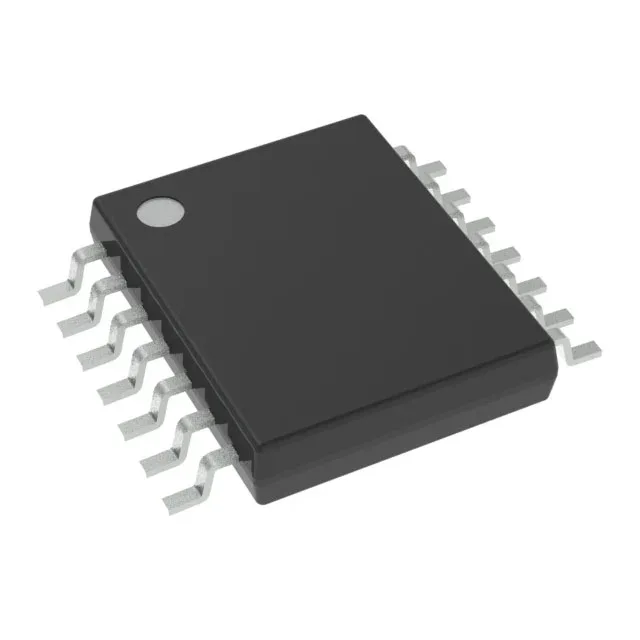
The Texas Instruments CD40106BPW is a 4000B-series CMOS hex inverter — six independent inverters in a single 14-TSSOP package — but the Schmitt-trigger input on every gate is what sets it apart from a plain CD4069 or 74HC04. Without hysteresis, a slow-rising input from an RC oscillator or a mechanical switch can cause multiple transitions or oscillation at the output. The CD40106BPW's Schmitt trigger cleans that up: the input logic levels are specified as 0.9 V to 4 V for low and 3.6 V to 10.8 V for high (at 5 V supply), so a noisy or slowly changing signal crosses the threshold cleanly once and stays there.
The 3 V to 18 V supply range lets this part bridge 5 V, 12 V, and 15 V logic domains without external level translation — useful in industrial controls where a single board might carry both a 3.3 V microcontroller and a 12 V relay driver. Quiescent current maxes out at 4 µA, so it's safe to leave powered in a battery-backed supervisory circuit without draining the coin cell.
Speed and drive — what the 120 ns propagation delay means for your bus
Maximum propagation delay is 120 ns at 15 V supply with a 50 pF load. Output sink and source current is 3.4 mA typical.
The supplier device package is 14-TSSOP.