What the 3V-to-18V supply range means for your rail
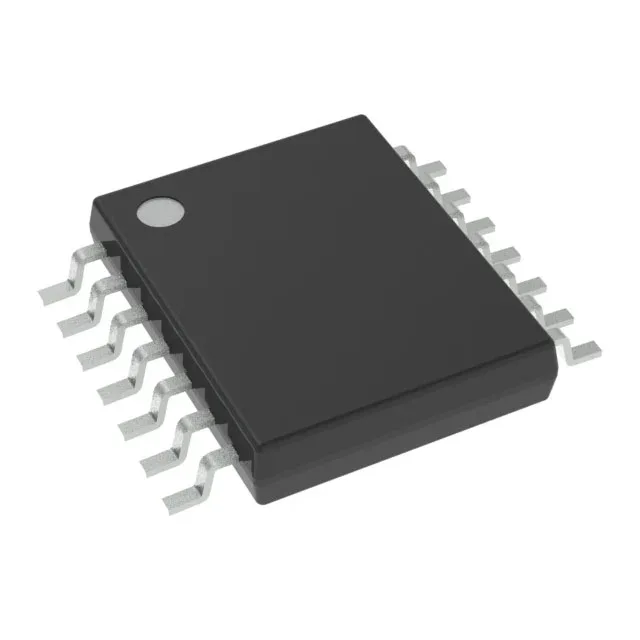
The CD4001BPW is a quad 2-input NOR gate from the 4000B series, running on a 3V to 18V supply — this is the classic unbuffered CMOS logic family that tolerates a wider rail than 74HC or 74AC parts, which top out at 6V or 5.5V respectively. The 1 µA max quiescent current means it draws essentially nothing in static logic states, so a battery-powered sensor node that sleeps most of the time sees negligible drain from the gate itself. Propagation delay is 90 ns typical at 15V with a 50 pF load — this is the speed ceiling for a 4000B gate at full rail. At lower supply voltages the delay increases, so if your clock edge needs to propagate through a chain of gates within 50 ns, you need the 15V rail or a faster logic family like 74AC.
Temperature grade and board-fit for harsh environments
A gate that sees the inside of an engine bay, a satellite orbit, or a downhole tool will hold its logic thresholds across that span without parametric drift in the input low/high levels (1.5V-4V low, 3.5V-11V high at the extremes).
Output drive and what 3.4 mA means for fan-out
The output sources or sinks 3.4 mA at the rated supply — this is a standard 4000B drive strength. It can drive one or two 74HC inputs (which draw about 1 µA each) but will struggle to drive a high-capacitance bus or a long trace without edge degradation. For a 50 pF load the 90 ns delay is the spec; add more capacitance and the rise time stretches beyond the datasheet limit.