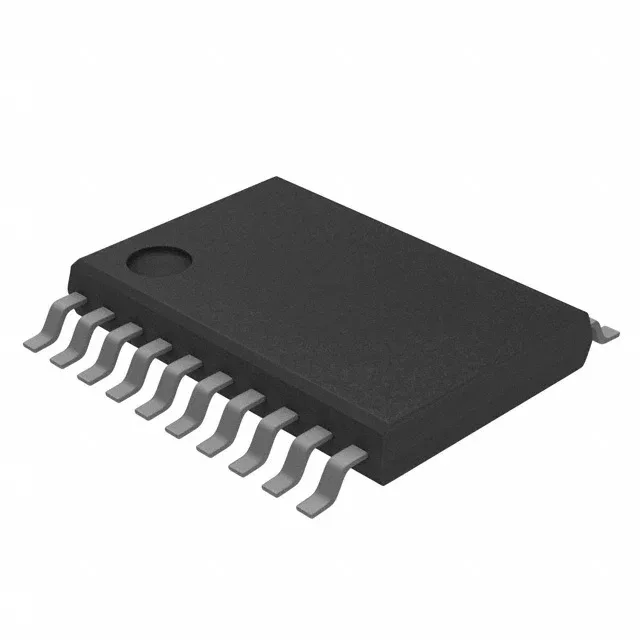
Automotive-grade 5V bus buffer — what the AEC-Q100 qualification means
The Texas Instruments CAHCT240IPWRG4Q1 is an automotive-qualified (AEC-Q100) inverting buffer with 3-state outputs from the 74AHCT logic family. It integrates two 4-bit elements into a single 20-TSSOP package, each independently gated, giving you an 8-bit bus isolation or line-driving stage that the OEM auditor will accept without a waiver — this is a qualified part, not an industrial part dressed up as automotive-capable. The supply range is a fixed 4.5V to 5.5V, so it belongs in a 5V logic rail, not a mixed-voltage or 3.3V domain. Output drive is rated 8mA per channel in both high and low states, sized for driving short PCB traces and standard CMOS loads, not heavy backplanes.
Temperature range: cabin and body electronics, not underhood
It does not meet grade-0 requirements for underhood or engine-bay locations — capable is not qualified, and the OEM auditor will ask for PPAP that matches the grade. If your thermal profile exceeds 85°C ambient, look at the SN74LVC2G17QDCKRQ1 which is also AEC-Q100 but rated to 125°C, though that part is a single-bit Schmitt-trigger buffer, not a direct functional match.
20-TSSOP footprint and surface-mount assembly
The part comes in a 20-TSSOP package (0.173" body width, 4.40mm nominal) with a 0.65mm lead pitch — a standard fine-pitch SOP footprint that reflows with conventional 0.1mm stencil apertures.