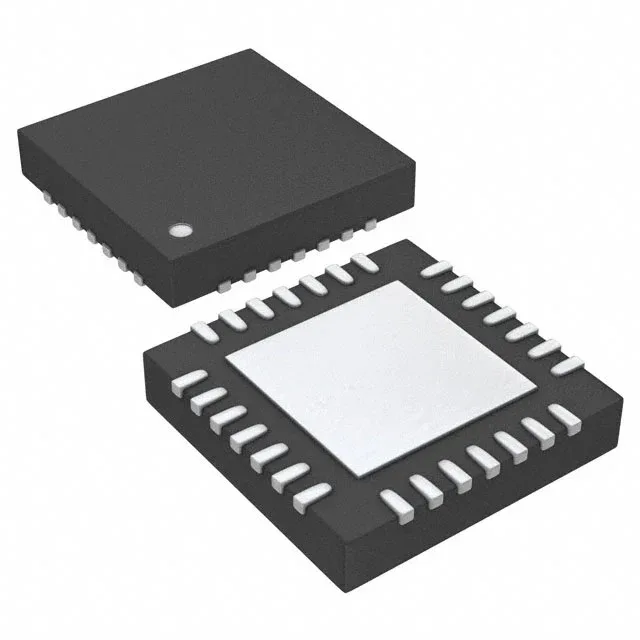
10A multi-chemistry charger in a 5x5 mm QFN
The BQ24751RHDT is a multi-chemistry battery charger IC from Texas Instruments, supporting 2 to 4 series cells with a programmable constant-current charge up to 10 A max. The IC integrates over-current and over-voltage fault protection, so a single-device charge controller handles the safety loop without an external supervisor. The battery pack voltage ceiling is 18.048 V max, which aligns with a 4-cell Li-ion stack at full charge (4.2 V/cell × 4 = 16.8 V, plus headroom for the charger regulation).
NRND — sourcing through independent channels
Texas Instruments has marked the BQ24751RHDT as NRND (Not Recommended for New Designs). This means the device is still available for existing production but is not intended for new board spins. For BOM lines already qualified to this part, independent distribution carries stock from authorized overruns and surplus lots. The date-code and marking consistency should be verified at receipt — the laser-etched TI logo and date-code font on the 28-VFQFN package is a known authenticity marker. Quoted to order against the RFQ; availability confirmed at quote time.
Temperature range and board integration
This covers engine-bay electronics, outdoor telecom cabinets, and any application where the ambient near the charger can exceed 85°C. The junction-to-ambient thermal resistance of the 28-VFQFN with the exposed pad soldered to a 2 oz copper plane is typically around 30-35°C/W — at 10 A charge current with a 0.5 V drop across the internal FETs (5 W dissipation), the junction rises about 150-175°C above ambient, so the die will hit the 125°C limit quickly unless the charge current is thermally derated or the duty cycle is low. Surface-mount assembly on a 28-VFQFN with a 0.50 mm pitch requires a solder-paste stencil aperture of 80-90% of the pad area to avoid bridging. The exposed paddle must be connected to the system ground plane with at least 9 thermal vias (0.30 mm drill, 0.60 mm pad) to keep the thermal impedance below 10°C/W from the paddle to the inner-layer copper.