Active production — what that means for your BOM
The ADS8323Y/250: ROHS3 compliant, so it passes the current EU material restriction without an exemption. No Pb-free transition gotchas on a legacy BOM that already runs 5V logic.
16-bit SAR, 500k SPS, differential — the signal-chain fit
This is a 16-bit successive-approximation ADC with a single differential input and a built-in sample-and-hold. The 500k samples-per-second rate means it can digitize a 250 kHz bandwidth signal at Nyquist — enough for vibration analysis, high-speed data acquisition, or closed-loop control in industrial instrumentation. The differential input rejects common-mode noise on the analog front-end, which matters when the sensor signal runs through a long twisted pair inside a panel full of switching supplies. Single-ended peers like the ADS7887SDCKT cannot do that — they reference the signal to ground and pick up every volt of ground bounce. Both the analog and digital supply rails are 5V — no mixed-voltage rail needed. That simplifies the power tree: one 5V rail feeds the ADC and the digital interface, and the reference can be either internal or external depending on whether you need ratiometric accuracy or a precision external reference.
Parallel interface — speed vs pin count trade-off
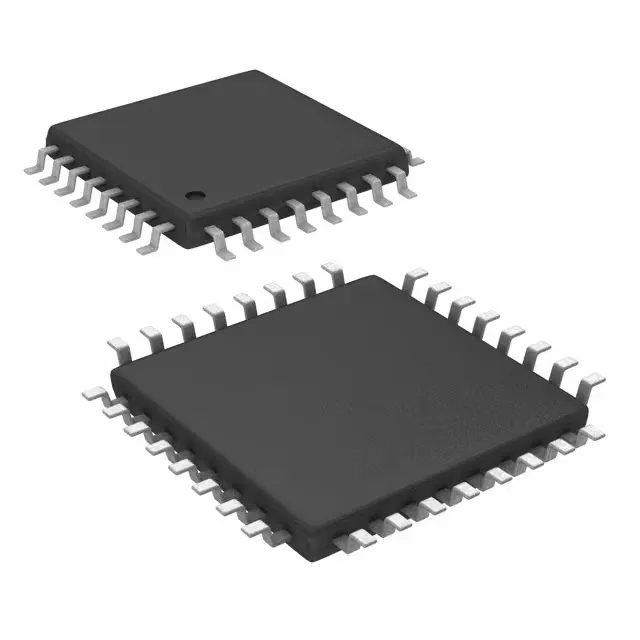
The data interface is parallel, not SPI. That gives you the full 500k conversions per second without a serial clock bottleneck — the host reads the 16-bit result in one bus cycle instead of shifting it out bit by bit. The trade-off is 16 data lines plus control signals, so the PCB fan-out needs more traces than a serial ADC would. The 32-TQFP package (5x5 mm) keeps the footprint compact despite the parallel bus. The 0.8 mm pitch is routable on a 2-layer board if you are careful with the digital trace lengths, but a 4-layer stack-up with a solid ground plane under the analog section is the safer call for 16-bit accuracy.
Temperature range and industrial deployment
A data-acquisition module on a factory floor that sees 70°C inside the enclosure still has 15°C of margin before the ADC hits its upper limit.