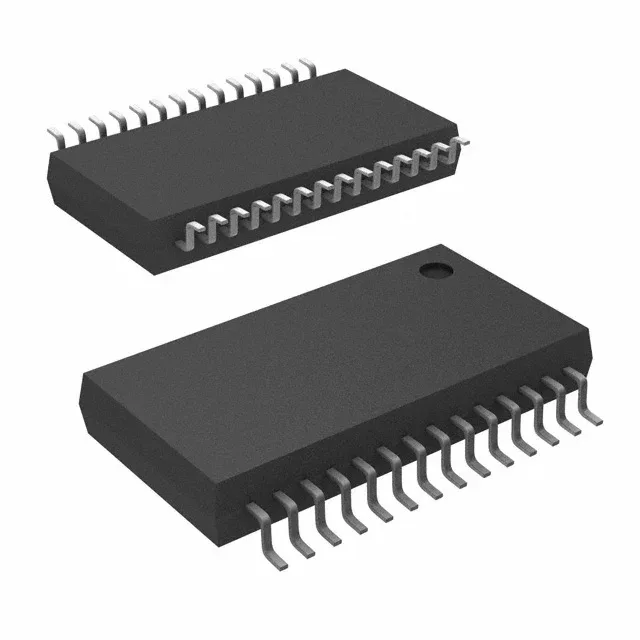
Texas Instruments ADS1256IDBR — Analog & Data Acquisition

ADS1256IDBR 24-Bit Sigma-Delta ADC, 30 kSPS, SPI, SSOP-28

MPNADS1256IDBR
Active

Texas Instruments ADS1256IDBR, 24-bit Sigma-Delta ADC, 30 kSPS, SPI, PGA, 8-channel differential/single-ended, SSOP-28, -40°C to 85°C.

$16.8300Ref. price · indicative, final on quote
StockContact for availability
MOQ1 pcs
  • 100% new & originalTraceable channels only — no refurbs, no pulls, no remarked parts.
  • Date & lot codes on quoteStated per line before you commit; label photos on request.
  • MSL-compliant ESD packingMoisture-sealed bags with indicator cards; reels photo-verified.
  • PayPal buyer protectionPay by T/T, PayPal or Payoneer — card payments covered end to end.

Specifications

ADS1256IDBR Technical Specifications
ParameterValue
Input typeDifferential, Single Ended
Mounting typeSurface Mount
Reference typeExternal
Voltage - supply, analog5V
Voltage - supply, digital1.8V ~ 3.6V
Number of inputs4, 8
InterfaceSPI
Operating temperature-40°C~85°C
PackageTape & Reel (TR); Cut Tape (CT)
FeaturesPGA
ArchitectureSigma-Delta
ConfigurationMUX-PGA-ADC
Number of bits24
Case28-SSOP (0.209\", 5.30mm Width)
Number of a (D converters)1
Sampling rate (Per second)30k

Product details

The Texas Instruments ADS1256IDBR is a 24-bit Sigma-Delta ADC with an integrated programmable gain amplifier (PGA) and an input multiplexer (MUX-PGA-ADC configuration). It samples at 30 kSPS and communicates over an SPI interface. The 24-bit resolution gives this ADC a theoretical dynamic range of about 138 dB, making it suitable for precision measurement applications like weigh scales, pressure transducers, and thermocouple interfaces where microvolt-level signals need to be resolved. The 30 kSPS sampling rate is fast enough for multiplexing across all eight inputs (single-ended) or four differential pairs without dropping below 3.75 kSPS per channel, which covers most industrial sensor readout rates.

Supply rails and signal interface — what to budget on the board

The PGA feature (listed as a key feature) provides gain settings that amplify small sensor signals before conversion, reducing the noise contribution from downstream stages. The input multiplexer accepts both differential and single-ended signals, with up to four differential or eight single-ended channels.

Frequently asked questions

Can ADS1256IDBR replace ADS1256IDB?

The ADS1256IDBR and ADS1256IDB share the same base product number (ADS1256) and identical electrical specifications. The difference is packaging: the 'R' suffix indicates tape-and-reel (suitable for pick-and-place), while the non-R variant typically ships in tubes. They are functionally identical and pin-compatible.

What is the resolution of ADS1256IDBR?

The ADS1256IDBR is a 24-bit ADC. This means it can resolve the analog input into 16,777,216 discrete steps, providing microvolt-level sensitivity when used with the internal PGA.

What is the accuracy of ADS1256IDBR?

Accuracy depends on the external reference voltage and the PGA gain setting. With a 5 V reference and the PGA set to unity gain, the least significant bit (LSB) size is approximately 0.298 µV. The Sigma-Delta architecture provides excellent noise shaping, but the effective number of bits (ENOB) will be lower than 24 bits at the full 30 kSPS rate — typically around 20 to 21 bits for most applications.