16-bit sigma-delta ADC in a SOT-23-6 — what it brings to a sensor front-end
The ADS1110A7IDBVR: It accepts either differential or single-ended inputs, making it a fit for bridge sensors, thermocouples, or ratiometric measurements where you need a clean digital reading without an external reference — the reference is internal. The on-chip programmable gain amplifier (PGA) lets you amplify small sensor signals before conversion, so a 10 mV full-scale thermocouple output can span most of the 16-bit code range. The selectable I2C address (one of eight via the A0/A1 pins) means you can hang up to eight of these on a single bus without an external mux. At 240 samples per second, this is a DC-to-low-frequency measurement part — think temperature logging, pressure transducers, or battery monitoring. It is not built for audio or vibration analysis above a few hundred hertz.
Supply rails and temperature — where this ADC lives comfortably
The single differential input channel with one internal ADC means you sample one sensor at a time. For multi-channel applications, you either add an external analog mux or use multiple ADS1110 devices on the I2C bus.
SOT-23-6 rework — what the hot-air station sees
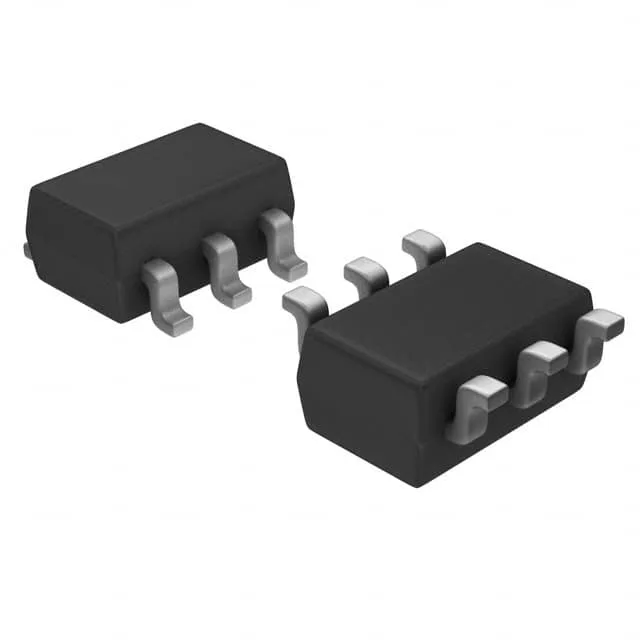
The SOT-23-6 package is small — about 2.9 mm by 1.6 mm — with 0.95 mm pitch leads. Under hot air it heats quickly; the trick is to preheat the board to 100°C-120°C first so the part doesn't cool the pad when it lands. The small thermal mass means it reflows fast — keep the nozzle at 300°C-320°C with low airflow and you'll lift the part, not the pad.
The base product number ADS1110 covers the whole family, with the A7 suffix indicating the I2C address and full-scale range variant.