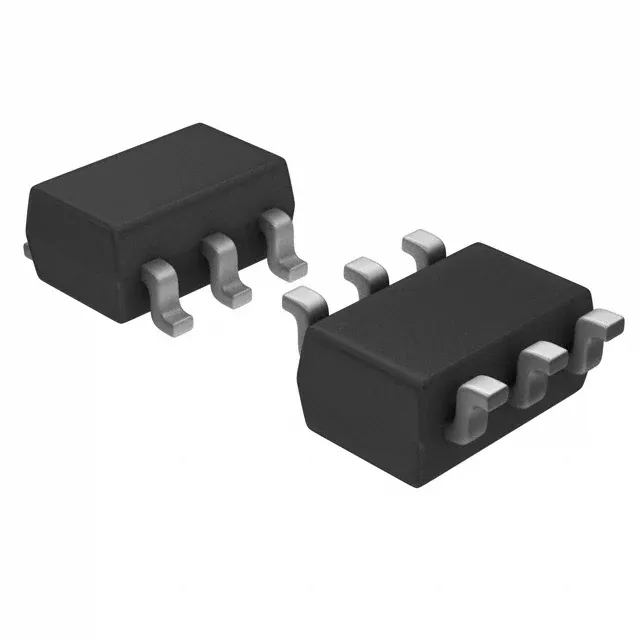
Active production, no obsolescence worries
SPDT switch with 300 MHz bandwidth — what it handles
This is a single-pole double-throw (SPDT) analog switch from the 74LVC family, built to route one common pin to either of two independent I/O pins. The 2:1 multiplexer/demultiplexer circuit means it can select between two signal sources or route a single signal to one of two destinations. The 300 MHz -3 dB bandwidth tells you it passes high-speed digital clocks, video signals, or RF envelopes up to the VHF band without rolling off—useful for switching between two antenna feeds or multiplexing a high-speed data line. On-resistance is 15 Ohm max. That resistance, combined with the 5.2 pF off-channel capacitance, sets the insertion loss and isolation at high frequencies.
Supply voltage range and temperature grade
That makes the part a natural fit for mixed-voltage boards where the switch needs to pass signals between different logic families.
Switching speed and charge injection
Turn-on time is 5.7 ns max, turn-off is 3.8 ns max, so the switch can handle fast multiplexing or signal gating without introducing timing skew. Charge injection is 7 pC typical, which is low enough that glitch energy on the signal path stays small—important when switching a sample-and-hold input or a precision ADC reference. Channel-to-channel on-resistance matching is 100 mOhm, so the two switch legs behave nearly identically. That matters when the switch is used in a differential signal path or a gain-setting network where the resistance balance affects accuracy.