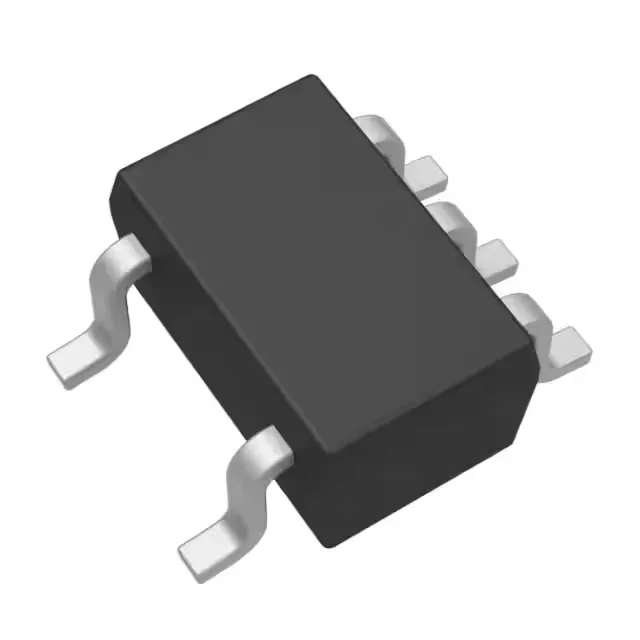
What this single-gate buffer does on your board
It belongs to the 74LVC family, which means it handles a wide supply range from 1.65V up to 5.5V, making it equally at home in a 1.8V FPGA I/O bank or a 5V legacy logic rail. Each output pin can source or sink 32mA, enough to drive a standard LED, a small relay coil through a transistor, or a handful of CMOS inputs without needing a separate line driver. The 3-state control lets you share a bus — pull the output enable low and the pin goes high-impedance, so another device can take over the line without contention. It comes in a 5-lead SC-70 package (also known as SOT-353), a compact surface-mount footprint that fits tight layouts.
Supply voltage and drive — where the 74LVC1G126DCKRE4 fits
At 1.8V it works with modern low-voltage MCUs and FPGAs; at 3.3V it's the default for most digital logic; at 5V it interfaces with older TTL-level peripherals. No level shifter needed if the rest of the rail is within that window. The 32mA output current is symmetrical — high and low drive are the same figure — so you don't have to derate for sink vs source. That matters when you're driving a bus line with a known capacitive load: the edge rate is consistent in both directions, which simplifies timing closure on a shared data line.
Cut Tape (CT)) mean it's available for both prototype picks and production reels.