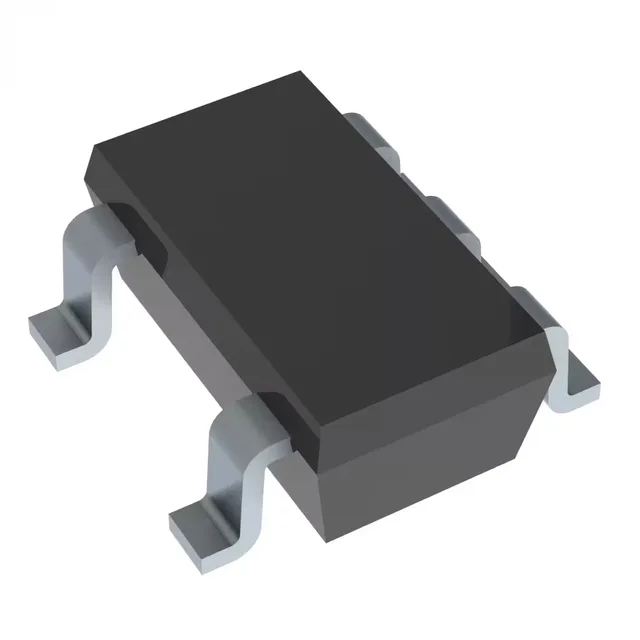
The Texas Instruments 74AHC1G125DBVTG4 is a single-bit, non-inverting buffer with a 3-state output, belonging to the 74AHC logic family. It takes a single input and drives a single output with the same logic level, but the output can be placed into a high-impedance state via the output-enable control (active-low, internal pull-up). This makes it useful for bus isolation, signal gating, or driving shared data lines where multiple drivers contend for the same wire. Output drive is symmetric at 8mA source and 8mA sink, enough to drive a handful of CMOS inputs or a small LED indicator through a series resistor. Packaged in a SOT-23-5 (SC-74A) footprint, it fits tight board layouts where a full SOIC-8 or larger package would waste space. The 5-pin configuration includes the usual VCC, GND, input A, output Y, and output-enable (OE) pins.
Supply voltage and level-shifting capability
The 2V to 5.5V supply range means this buffer can operate on a 3.3V rail and still accept 5V-tolerant inputs? Not exactly — the 74AHC family inputs are not 5V-tolerant when powered at 3.3V; the input high threshold scales with VCC. For level shifting from a 5V output to a 3.3V input, the 74AHC1G125 can work if the 5V signal is within the absolute maximum ratings (typically VCC + 0.5V), but a dedicated level translator or an AHC part with overvoltage-tolerant inputs is safer. For 3.3V to 5V translation, the 3-state output can drive a 5V rail when VCC = 5V, but the input must be at 3.3V logic levels, which the AHC family accepts as high.
The part is not subject to allocation or factory lead-time delays typical of high-volume commodity logic families.