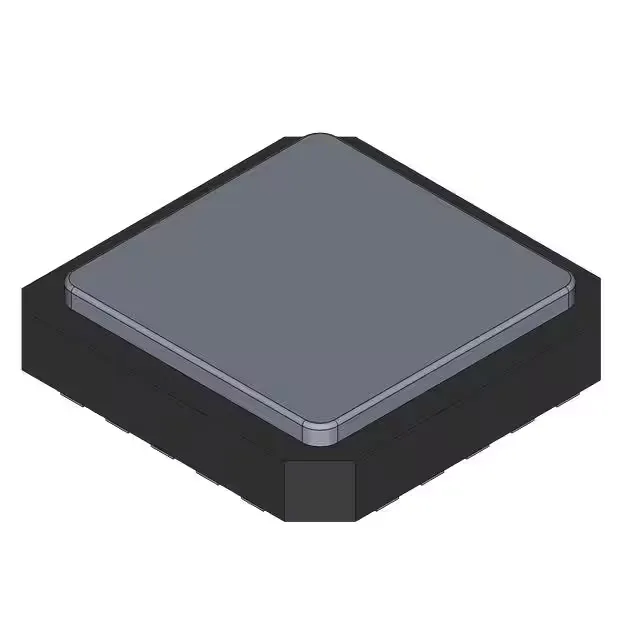
AEC-Q100 dual op-amp in hermetic ceramic — for harsh environments
It delivers a gain-bandwidth product of 5.3 MHz with a very low slew rate of 0.02 V/µs, drawing just 100 µA per channel. The rail-to-rail output stage allows maximum signal swing on low supply rails, and the 1 pA input bias current suits high-impedance sensor interfaces.
Package and temperature — the ceramic advantage
The 20-LCCC (leadless ceramic chip carrier) is a hermetic package that prevents moisture ingress, a critical requirement for long-life missions in space, defense, and high-reliability industrial systems. Surface-mount assembly on ceramic substrates is standard; the 8.89x8.89 mm footprint matches typical LCCC land patterns.
Slew rate and bandwidth — design for low-frequency precision
Instead, it excels in low-frequency signal conditioning, such as filtering, sensor amplification, and control-loop compensation where low power and precision matter more than speed. The 5.3 MHz gain-bandwidth product provides adequate gain at audio and low ultrasonic frequencies, while the 300 µV input offset voltage (typical) and 1 pA input bias current keep DC errors small even with high source impedances.
The rail-to-rail output can source or sink up to 50 mA per channel, sufficient to drive moderate loads like analog multiplexers or small relays. Total quiescent current for both amplifiers is 200 µA, making it viable for always-on sensor modules in battery-backed systems.
Lifecycle and sourcing — active, but channel matters
However, because it is a ceramic-package, AEC-Q100 qualified part with a military temperature range, it is typically not a high-volume stock item at general-purpose distributors. For buyers filling a BOM line for a defense, aerospace, or long-life automotive program, this part is available — but expect to work through a qualified broker or specialty distributor who can verify date-code consistency and lot traceability, especially given the hermetic package's sensitivity to counterfeit re-marking.