Key ratings that drive the BOM decision
Gain bandwidth product sits at 210 kHz with a 0.12 V/µs slew rate — this is a low-speed part, not for audio or fast ADC drivers. The trade-off is the 80 µA per-channel supply current: in a dual-channel design you burn 160 µA total quiescent, which keeps the power budget tight in always-on automotive modules or remote sensors. Input bias current is 1 pA typical, so you can use high-impedance sources like pH probes or piezoelectric sensors without worrying about offset drift from bias current. Input offset voltage is 200 µV, which is decent for a general-purpose CMOS amp — fine for 12-bit systems with a 3 V reference. Supply span runs from 4.4 V to 16 V, covering 5 V and 12 V rails common in automotive and industrial control.
Package and temperature grade — the deployment envelope
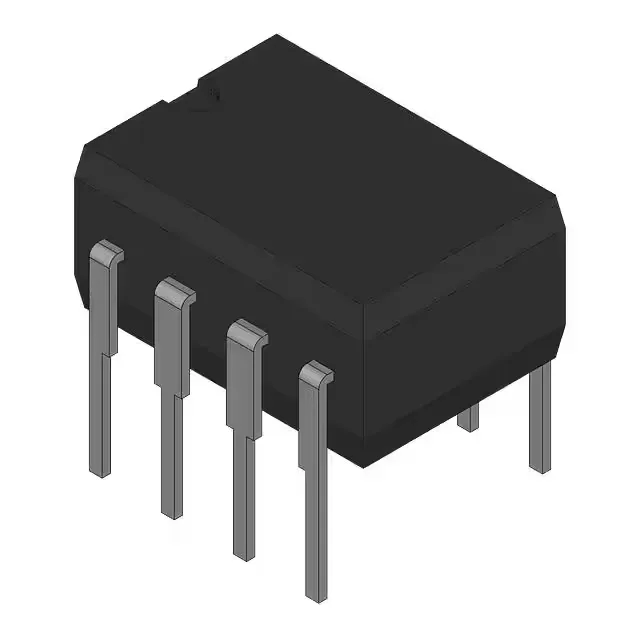
Housed in an 8-pin ceramic DIP (8-CDIP, 0.300" body width), this is a through-hole part — no reflow, no moisture sensitivity level to track. The ceramic package seals the die against moisture and outgassing, which is why you see it in avionics, downhole tools, and military comms where plastic encapsulants are not trusted.
The AEC-Q100 qualification and ceramic package mean it is specified into long-life programs where a last-time-buy would be painful.