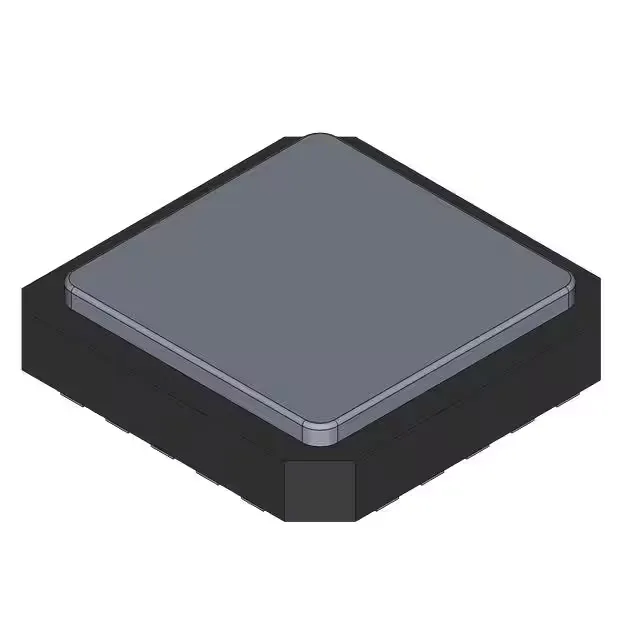
Hermetic quad op-amp for harsh environments
The 5962-9088106Q2A is a quad general-purpose operational amplifier from the Automotive, AEC-Q100 series, packaged in a hermetic 20-CLCC (ceramic leadless chip carrier) with a 20-LCCC footprint (8.89x8.89 mm). This part is designed for signal conditioning, sensor amplification, and general-purpose analog processing in avionics, satellite, downhole, and other sealed-environment systems where the ceramic package and wide temperature range are mandatory.
The slew rate limits large-signal response: a 10 V output step takes about 20 µs to settle, so it is not suitable for fast ADC drivers or video buffers. For a design that needs to condition a 100 Hz strain-gauge bridge or a 1 kHz temperature sensor, the 1.7 MHz GBW leaves plenty of loop gain for precision.
Hermetic 20-CLCC — why the package matters
This is the package you specify when the board must survive condensation, altitude cycling, or corrosive atmospheres — avionics, missile guidance, satellite payloads, and down-hole tools. The 20-LCCC footprint (8.89x8.89 mm) is a standard ceramic land pattern; rework requires a hot-air station with a fine nozzle, and the package is moisture-sensitive at MSL 1 (no bake needed if stored dry). The ceramic body also handles higher junction temperatures than plastic packages, which matters when the part is dissipating the 40 mA per channel output current near the 125°C end of the range.
The supply span from 4 V to 40 V covers both single-supply (e.g., 5 V or 12 V) and split-supply (e.g., ±2 V to ±20 V) rails. Each channel can deliver 40 mA of output current, which is enough to drive a moderate load — a 100 Ω resistor at 4 V output draws 40 mA, right at the limit. The total supply current for all four channels is 1.05 mA, so the quiescent power is low (about 4.2 mW at 4 V, 42 mW at 40 V). This makes the part suitable for battery-powered or power-constrained systems where the ceramic package is needed for reliability.
It is listed under the Automotive, AEC-Q100 series, which indicates qualification for automotive-grade reliability — though the hermetic ceramic package and military temperature range make it equally at home in defence and aerospace BOMs. There is no official second-source or successor listed in the manufacturer's cross-reference, so dual-sourcing would require a separate qualification of a functionally equivalent quad op-amp in a similar ceramic package.