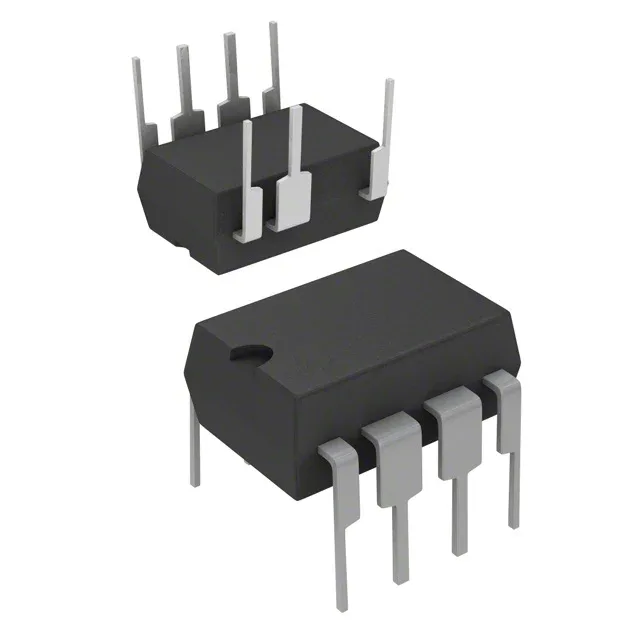
STMicroelectronics VIPER26LN — Power Management (PMIC / Gate Driver)

VIPER26LN STMicroelectronics 20 W Flyback Switching

MPNVIPER26LN
Active

STMicroelectronics VIPer™ plus series, VIPER26LN, offline switching regulator, flyback topology, 20 W output, 800 V breakdown, 60 kHz switching, 7-DIP through-hole package.

$1.4700Ref. price · indicative, final on quote
Packaging8-DIP (0.300", 7.62mm), 7 Leads
RoHSROHS3 Compliant
SeriesVIPer™ plus
Independent supplier — new & surplus stockAuthenticity-screened · ESD-safe packingListing updated Aug 2026

Specifications

VIPER26LN specifications
ParameterValue
SeriesVIPer™ plus
MountingThrough Hole
Voltage - start up13 V
Voltage - breakdown800V
Voltage - supply (Vcc (Vdd))11.5V ~ 23.5V
Power (Watts)20 W
Frequency - switching60kHz
Duty cycle70%
Operating temperature-40°C ~ 150°C (TJ)
PackageTube
TopologyFlyback
Case8-DIP (0.300\", 7.62mm), 7 Leads
Fault protectionCurrent Limiting, Over Temperature
Output isolationEither
Internal switchYes

Product details

Flyback converter with integrated 800 V MOSFET

The VIPER26LN is a monolithic offline switcher from ST's VIPer™ plus family that integrates the PWM controller and an 800 V avalanche-rugged power MOSFET in a single 7-DIP through-hole package. It is designed for flyback converters delivering up to 20 W — think auxiliary supplies for motor drives, battery chargers, and industrial control boards where a discrete MOSFET-and-controller pair would eat board space and add BOM lines.

60 kHz switching, 70 % duty-cycle ceiling

The fixed 60 kHz switching frequency is a pragmatic choice: fast enough to keep the flyback transformer small, slow enough to avoid the snubber losses that 100 kHz+ designs wrestle with at 20 W. The 70 % maximum duty cycle gives enough on-time for universal AC input (85–265 VAC) without saturating the core — you size the primary inductance around that duty limit, not the other way around. Start-up is handled internally with a 13 V threshold, and the supply range from 11.5 V to 23.5 V covers the Vcc rail tolerance you get from an auxiliary winding without an external linear regulator.

Fault protection set — current limit and OTP

On-chip current limiting and over-temperature shutdown mean you do not need an external sense resistor or a thermistor for basic protection. The current limit is set internally; the OTP threshold is tied to the junction temperature, so the thermal pad on the PCB (the copper area under the 7-DIP body) directly affects the power level at which the part trips. Mind the dead-time on the feedback loop — the hiccup-mode restart after a fault cycles the bias supply, and the start-up resistor must be sized to recharge the Vcc cap within the hiccup period.

Frequently asked questions

What is the output power of VIPER26LN?

The VIPER26LN is rated for 20 W in a flyback topology. That figure assumes adequate heatsinking and the full 70 % duty cycle; in a sealed enclosure with limited airflow, the 150 °C junction temperature limit becomes the binding constraint.

Does VIPER26LN have overcurrent protection?

Yes, the VIPER26LN includes on-chip current limiting and over-temperature shutdown. The current limit is internally fixed; no external sense resistor is required.

What is the difference between VIPER26LN and VIPER26LD?

The two share the same die and electrical ratings — 800 V breakdown, 60 kHz switching, 20 W output. The difference is the package: VIPER26LN is a 7-DIP through-hole, while the LD variant is a surface-mount SO-8. The pinout differs between the two packages, so they are not drop-in replacements on the same PCB footprint.