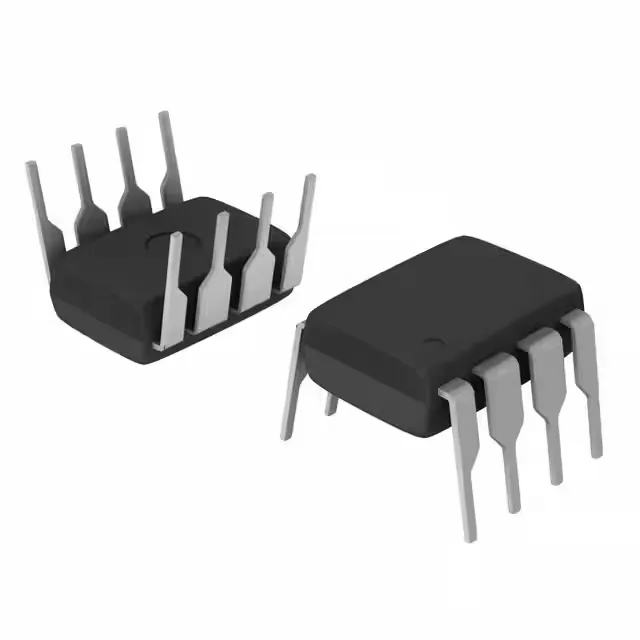
13 W offline flyback — the 730 V breakdown buys mains headroom
The STMicroelectronics VIPER12ADIP-E is a monolithic offline switching regulator from the VIPER™ family, integrating a 730 V avalanche-rugged power MOSFET and a PWM controller in an 8-DIP through-hole package. It delivers up to 13 W in a non-isolated flyback topology, with a fixed 60 kHz switching frequency that simplifies transformer design at the cost of some EMI tuning flexibility. The 730 V breakdown rating provides ample margin for universal mains (85–265 VAC) applications, absorbing line transients without external clamping. The 13 W power ceiling suits auxiliary supplies, appliance control boards, and industrial bias rails where a discrete MOSFET-plus-controller solution would consume more board area and BOM line items.
Three integrated fault protections — current limiting, over-temperature, and over-voltage — eliminate the need for external sense resistors, thermistors, or OVP comparators. The over-voltage protection monitors the Vcc winding; a fault latches the controller off until the input is cycled, which is the standard behaviour for a self-supplied flyback. In a real 13 W flyback running in a 70°C ambient, the junction will sit well below 125°C with adequate copper on the 8-DIP's heatsink tabs — the 150°C ceiling gives headroom for fault conditions like output short circuits that drive the die temperature up before the thermal protection engages. Supply voltage range is 9 V to 38 V (Vcc/Vdd), with a 14.5 V start-up threshold. The wide Vcc range allows the auxiliary winding to self-supply the IC after start-up across varying output loads, which is typical for a flyback where the Vcc winding voltage tracks the output.
The base product number VIPER12 covers multiple package and lead-free variants; the -E suffix denotes the lead-free / RoHS-compliant version in the 8-DIP package.