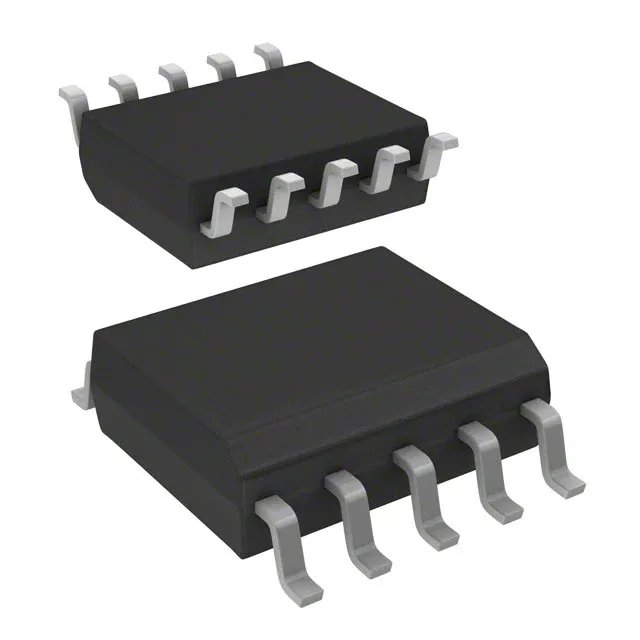
800 V breakdown, 12 W output — the offline flyback workhorse
The STMicroelectronics VIPER113XSTR is an offline switching regulator from the VIPER™ family, integrating a 800 V avalanche-rugged power MOSFET and a PWM controller in a single 10-SOP package. It delivers up to 12 W in a flyback, buck, or buck-boost topology, with a fixed 30 kHz switching frequency that keeps the EMI filter small and the snubber loss predictable.
Fault protection set — what it covers without external parts
On-chip fault protection includes current limiting, over-load, over-voltage, and short-circuit detection. That covers the four failure modes an offline flyback sees most: output short, feedback-loop open, input surge, and transformer saturation. No external supervisory IC or OVP crowbar needed for basic compliance. The soft-start control feature ramps the duty cycle on power-up, preventing output overshoot and inrush current that would otherwise trip the current limit on the first few cycles. This is standard on modern controllers but worth confirming if migrating from an older fixed-frequency part without it.
30 kHz switching — the trade-off between transformer size and EMI cost
At 30 kHz the transformer core is larger than what a 65 kHz or 100 kHz controller would need, but the conducted EMI spectrum stays below 150 kHz, where the quasi-peak limit is relaxed. For a 12 W auxiliary supply the extra turns on a standard EE16 or EE20 core are cheap; the LC input filter is what saves board area. The 80% maximum duty cycle gives enough headroom in a buck topology to regulate a 5 V output from a 24 V input without skipping pulses — useful for industrial bus-powered supplies where the input rails swing from 18 V to 30 V.
Package and footprint — 10-SOP with 3.90 mm width
Surface-mount assembly suits automated pick-and-place. The Tape & Reel variant is the standard ordering option for volume production; Cut Tape is available for prototyping or small-batch builds.