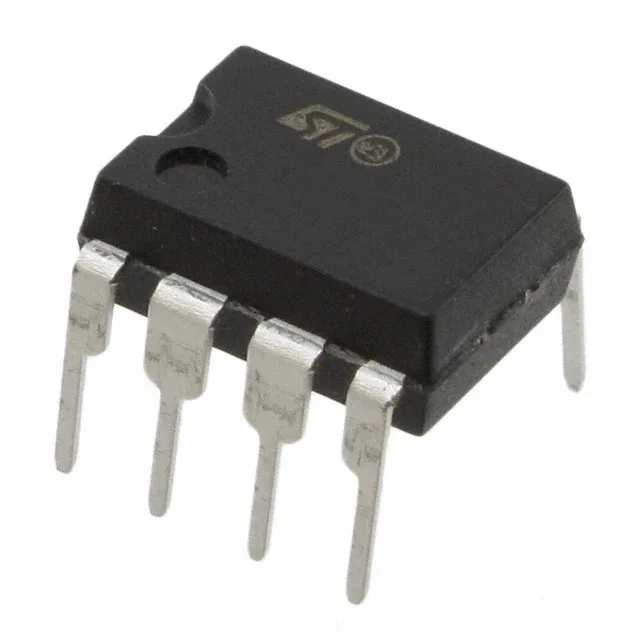
What the VIPER06HN is and what it delivers
The VIPER06HN is an offline switching regulator from STMicroelectronics' VIPer™ plus series, integrating the power MOSFET and controller in a single 7-lead DIP package. It supports both buck and flyback topologies, with a maximum output power of 8 W and an 800 V breakdown voltage that gives comfortable margin for universal AC input (85–265 VAC) rectified rails. The switching frequency is fixed at 115 kHz, a common choice that keeps the transformer or inductor small while staying below the AM radio band. The duty cycle ceiling is 70 %, which limits the step-down ratio in a buck converter but is typical for flyback designs.
Key ratings that matter for the BOM
The 8 W power rating is the continuous output the part can deliver in a typical flyback at 230 VAC input — derate for low-line (85 VAC) operation, where the available power drops roughly by the square of the input voltage ratio. The 800 V breakdown ensures the MOSFET survives the reflected voltage spike plus leakage inductance ring in a flyback without an external snubber eating efficiency. Supply voltage range is 11.5 V to 23.5 V on the Vcc pin, with a 13 V startup threshold — the part starts when the bulk capacitor charges to 13 V, then runs from the auxiliary winding once the output is up. Fault protection includes current limiting, open-loop detection, and over-temperature shutdown, which covers the common failure modes in a low-cost offline supply. The through-hole 7-DIP package is a straightforward hand-solder or wave-solder fit — no fine-pitch reflow required.
That means it is safe to design into new BOMs and the supply channel is open for both sample and volume orders. It is ROHS3 compliant, so no exemption expiry concern for EU-market products.
Design-in checklist for the 7-DIP package
The through-hole leads handle the thermal dissipation; no exposed pad or heatsink is required at 8 W if the copper area on the drain pin is adequate. For a flyback design, the output isolation can be either isolated or non-isolated — the controller itself does not enforce isolation; the transformer and optocoupler loop do. In a buck configuration, the output is referenced to the input return, so no isolation transformer is needed.