Low-power quad op-amp for battery and sensor front-ends
The STMicroelectronics TSV714IPT is a quad CMOS operational amplifier drawing just 10 µA per channel from a 1.5 V to 5.5 V supply. With a gain-bandwidth product of 150 kHz and rail-to-rail output, it is sized for low-frequency signal conditioning in battery-powered instruments, portable medical devices, and industrial sensor interfaces where supply current is the primary constraint.
What the 10 µA per channel and 150 kHz GBP mean for the BOM
The 10 µA supply per channel (40 µA total for the quad) is the headline spec — this part exists for designs where every microamp on the analog rail is budgeted. The 150 kHz GBP and 0.06 V/µs slew rate tell you this is not a fast amplifier; it is meant for DC or low-frequency signals: thermocouple amplifiers, strain-gauge bridges, battery-voltage monitors, or photodiode front-ends below a few kilohertz. The 56 mA output per channel is unusually high for a micropower op-amp, so it can drive a downstream ADC input or a modest load without a separate buffer.
Package and temperature grade — fit for production
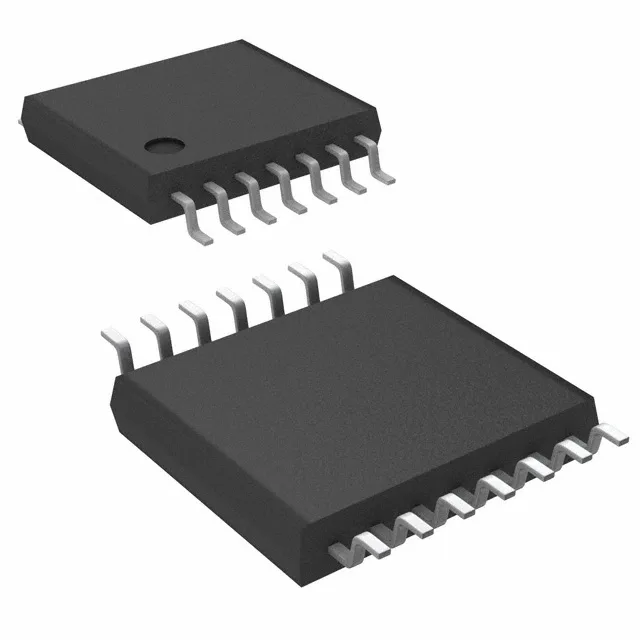
Housed in a 14-TSSOP (4.40 mm width) surface-mount package, the TSV714IPT fits on compact PCBs where board area is tight. The laser-etch on the package body should match ST's standard font and plant code for the date-code week; any mismatch in marking consistency is a flag for gray-market stock.
There is no LTB window or NRND flag, so it remains qualified for new production builds. For dual-sourcing resilience, the closest functional sibling in the same CMOS family is the TSV621ICT — a single-channel part with 420 kHz GBP and 0.14 V/µs slew rate, but the same 1 pA input bias and 1.5 V minimum supply.