9 kHz GBW and 650 nA per channel — the battery-life op-amp
The STMicroelectronics TSU104IPT is a quad CMOS operational amplifier designed for applications where power consumption is the primary constraint. Its 9 kHz gain-bandwidth product and 650 nA supply current per channel place it in the nano-power class, suitable for always-on sensor conditioning, battery monitoring, and portable instrumentation that must run for years from a coin cell or single-cell alkaline battery. The rail-to-rail output stage preserves dynamic range at low supply voltages, and the 1 pA typical input bias current allows direct interfacing with high-impedance sources such as photodiodes, pH probes, and piezoelectric sensors without an external buffer.
Supply range and single-supply operation
The 1.5 V minimum means it runs directly from a single alkaline cell (nominal 1.5 V) or a NiMH cell (1.2 V with headroom), eliminating the need for a boost converter in single-cell designs. The 5.5 V maximum covers two-cell alkaline, standard 3.3 V regulated rails, and 5 V logic supplies. The rail-to-rail output swings within millivolts of both rails, which is critical for maximizing ADC input range or driving a comparator threshold when the supply is only 1.5 V. This part is fully specified for single-supply operation across the entire voltage range.
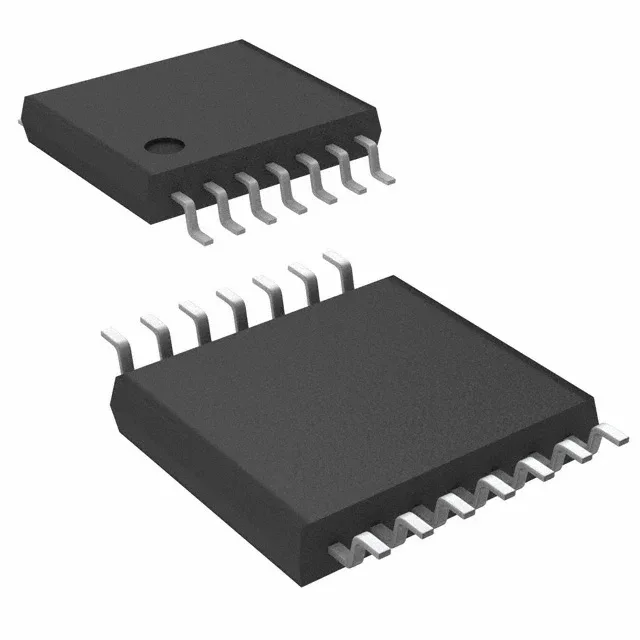
The 14-TSSOP package and ROHS3 compliance suit standard surface-mount assembly and current regulatory requirements.
The ROHS3 compliance is current for global markets including EU and UKCA jurisdictions.
Output drive and slew rate
Each of the four channels can source or sink 11 mA of output current, which is sufficient to drive a reference input, a small LED indicator, or the analog input of a low-power ADC. The slew rate of 0.003 V/µs is consistent with the 9 kHz GBW — this is a slow amplifier by design. It is not intended for audio, fast ADC driving, or any signal path above a few hundred hertz. The low slew rate also contributes to the nano-power budget by limiting internal charging currents.