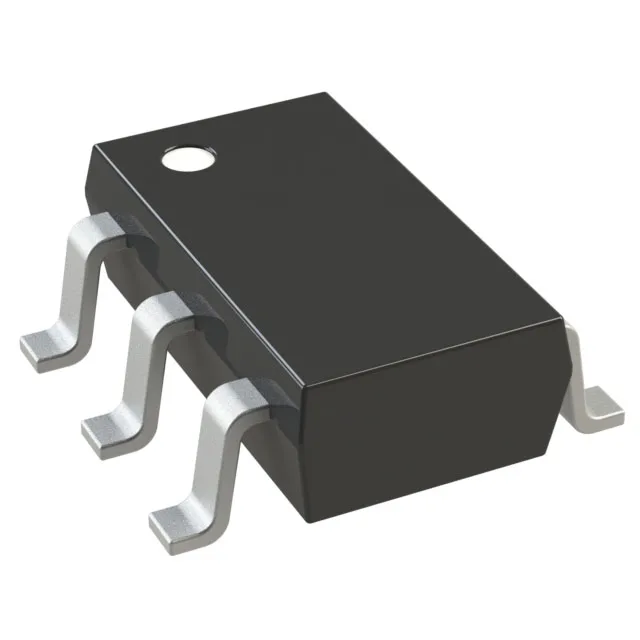
SOT-23-5 comparator with open-drain output
The TS7221AILT: Supply range is 2.7 V to 10 V single supply, or dual supplies if your design uses split rails.
What the key specs mean for your BOM
Input offset voltage is 7 mV max at 5 V — this sets the detection threshold accuracy. For a precision window comparator or a low-side current-sense trip point, budget that 7 mV into your threshold calculation; the typical offset is lower, but the datasheet guarantees the max. Input bias current is 300 pA max at 5 V. That is low enough that a high-impedance sensor (e.g., a 100 kΩ thermistor divider) sees negligible voltage error from the comparator input — the bias current drops less than 30 µV across that impedance, well below the offset budget. CMRR is 70 dB typical, PSRR 80 dB typical. These numbers tell you how much common-mode noise on the inputs or ripple on the supply rail couples through to the output decision. At 70 dB CMRR, a 1 V common-mode shift produces roughly 0.3 mV of input-referred error — fine for a 7 mV offset part, but worth knowing if the input signal rides on a noisy ground or a battery voltage that sags. The comparator's switching behaviour and offset stay within spec across that band, so it can sit in an outdoor enclosure or an unventilated control cabinet.