Why grab this comparator instead of a generic LM393
That means it's not just a bench part — it's specced for under-hood electronics, engine control modules, transmission sensors, and any environment where the PCB sees under-hood heat cycles or cold starts. The SOT-23-5 package keeps the footprint small enough for dense automotive ECU layouts, and the 2V to 36V single-supply range (or ±1V to ±18V dual) lets it run directly off a 3.3V sensor rail or a 24V truck battery without an extra regulator.
Supply voltage range — one part for 3.3V, 5V, 12V, and 24V rails
The 2V to 36V single-supply range (or ±1V to ±18V split supply) is the headline flexibility spec. In a typical automotive application, the same comparator can monitor a 3.3V MCU supply for undervoltage, check a 5V sensor reference, and flag an overvoltage on a 24V truck battery — all without changing the BOM. The 5mV max input offset voltage at 5V sets the practical threshold resolution: if you're building a window comparator to detect a 4.5V undervoltage on a 5V rail, the offset adds a ±5mV uncertainty, which is fine for most fault-detection margins. The 0.25µA max input bias current means you can feed it from a 100kΩ resistor divider and the voltage error stays under 25µV — no buffer amplifier needed.
Output compatibility — no level shifter needed
The output stage is listed as compatible with CMOS, DTL, ECL, Open-Collector, and TTL logic families. In practice, the open-collector output is the most common configuration for this class of comparator — it lets you pull up to any voltage up to the supply rail, so the output can drive a 3.3V MCU GPIO directly even when the comparator is running from 12V.
Package and hand-solderability
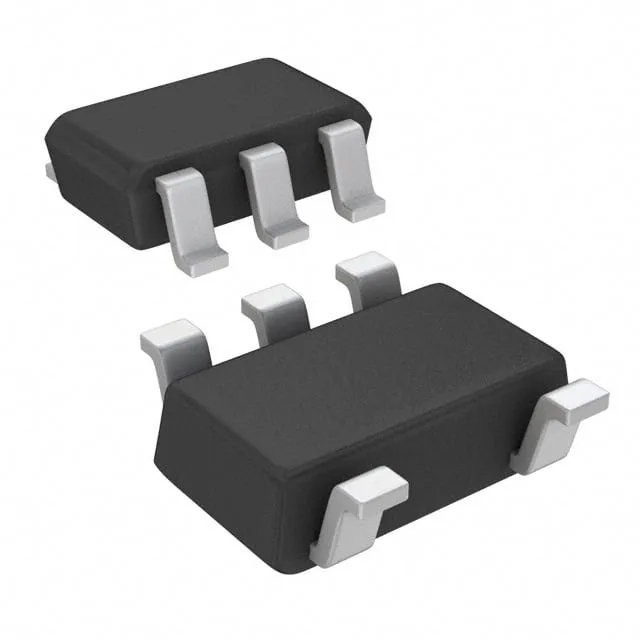
The SOT-23-5 (SC-74A / SOT-753) is one of the more hand-solderable five-pin SMD packages — the leads are on a 0.95mm pitch, visible under a loupe, and you can tack them with a fine-tip iron and flux. No thermal pad underneath, so no via-stitch requirement. For a prototype run or a rework station, this is a practical footprint. The 1.25mA max quiescent current is modest — not a micropower part, but fine for always-on automotive modules where the ignition-off load is handled by a separate sleep circuit.
For a new automotive design or a production BOM line, you can qualify it without worrying about an imminent EOL notice. The AEC-Q100 qualification means it's already passed the stress tests (HTOL, TC, HAST, etc.) that automotive Tier-1s require, so the qualification effort for an ECU program is mostly paperwork.