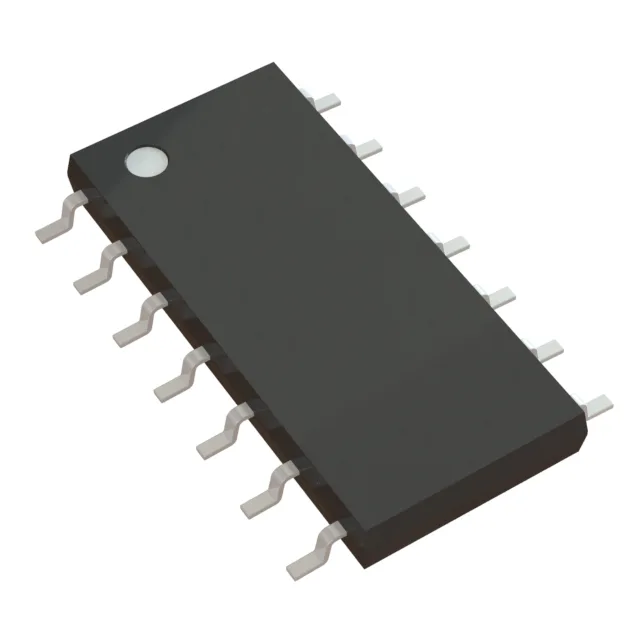
STMicroelectronics TS27L4AIDT — Logic ICs

STMicroelectronics TS27L4AIDT CMOS Quad Op-Amp, 100 kHz

MPNTS27L4AIDT
End of Life

STMicroelectronics TS27L4AIDT, CMOS quad operational amplifier, 100 kHz gain bandwidth, 0.04 V/µs slew rate, 10 µA per channel supply, 1 pA input bias, 14-SOIC package, -40°C to 125°C.

$2.08Ref. price · indicative, final on quote
Packaging14-SOIC (0.154", 3.90mm Width)
StockContact for availability
MOQ1 pcs
  • 100% new & originalTraceable channels only — no refurbs, no pulls, no remarked parts.
  • Date & lot codes on quoteStated per line before you commit; label photos on request.
  • MSL-compliant ESD packingMoisture-sealed bags with indicator cards; reels photo-verified.
  • PayPal buyer protectionPay by T/T, PayPal or Payoneer — card payments covered end to end.

Specifications

TS27L4AIDT Technical Specifications
ParameterValue
Mounting typeSurface Mount
Amplifier typeCMOS
Voltage - input offset900 µV
Voltage - supply span16 V
Current - supply10µA (x4 Channels)
Current - input bias1 pA
Current - output (Channel)45 mA
Operating temperature-40°C ~ 125°C
Gain bandwidth product100 kHz
PackageTape & Reel (TR); Cut Tape (CT)
Slew rate0.04V/µs
Case14-SOIC (0.154\", 3.90mm Width)
Number of circuits4

Product details

Ultra-low-power CMOS quad op-amp for sensor conditioning

The STMicroelectronics TS27L4AIDT is a quad CMOS operational amplifier designed for applications where supply current is the primary constraint. Each of the four channels draws 10 µA, making the total quiescent current 40 µA for the entire package. The gain bandwidth product is 100 kHz with a slew rate of 0.04 V/µs, which places this part firmly in the domain of DC and low-frequency signal conditioning — think thermocouple amplifiers, strain-gauge bridges, battery-voltage monitoring, and photodiode front ends where the signal changes slowly. Input bias current is 1 pA, so it does not load high-impedance sources.

The 14-SOIC (3.90 mm width) package is a standard JEDEC outline, so PCB layout is straightforward and second-source footprints are widely available. The ROHS3 compliance covers the current EU directive without exemptions.

What the 0.04 V/µs slew rate means for the BOM

A slew rate of 0.04 V/µs limits the large-signal bandwidth to roughly 6.4 kHz at 1 V peak output. This is not a part for audio line drivers, switching power-supply error amplifiers, or any loop that must settle quickly. It is, however, perfectly adequate for filtering and amplifying DC-coupled sensor outputs where the signal of interest changes at a few hertz to a few hundred hertz. The 100 kHz gain bandwidth supports closed-loop gains up to about 100 before the -3 dB point drops below 1 kHz. If your design needs to pass a 10 kHz square wave cleanly, look at a faster CMOS op-amp like the TS274 (3.5 MHz GBW, 5.5 V/µs slew rate) — but that part draws 1 mA per channel, 100× the supply current.

Output drive and input offset

Each channel can source or sink 45 mA, which is generous for a micropower op-amp and enough to drive a 2 kΩ load to within a volt of the rails. Input offset voltage is specified at 900 µV maximum — not precision territory, but acceptable for general-purpose sensor interfaces where the signal is several millivolts or more. The CMOS input stage gives the 1 pA bias current, so source impedance up to 1 MΩ does not create a significant voltage error.

Frequently asked questions

Is TS27L4AIDT rail-to-rail?

No, the TS27L4AIDT is not a rail-to-rail input or output op-amp. The CMOS output stage can swing close to the rails with a light load, but the input common-mode range does not include the positive rail. For true rail-to-rail operation, a different amplifier family would be needed.

What is the power consumption of TS27L4AIDT?

Each of the four channels draws 10 µA of supply current, so the total quiescent current for the package is 40 µA. At a 5 V supply, that is 200 µW total quiescent power. This is the defining characteristic of the part — it is designed for battery-powered and energy-harvesting applications where every microamp is budgeted.

Can TS27L4AIDT replace TS27L4AID?

The TS27L4AIDT and TS27L4AID are the same silicon in the same 14-SOIC package; the 'T' suffix typically denotes tape-and-reel packaging. Electrically they are identical. The TS27L4AIDT is the tape-and-reel variant, which is the standard ordering code for volume production. If your BOM calls for TS27L4AID, the TS27L4AIDT is a direct substitute.

What is the equivalent or replacement for TS27L4AIDT?

For a faster alternative with higher supply current, the TS274 offers 3.5 MHz GBW and 5.5 V/µs slew rate at 1 mA per channel.