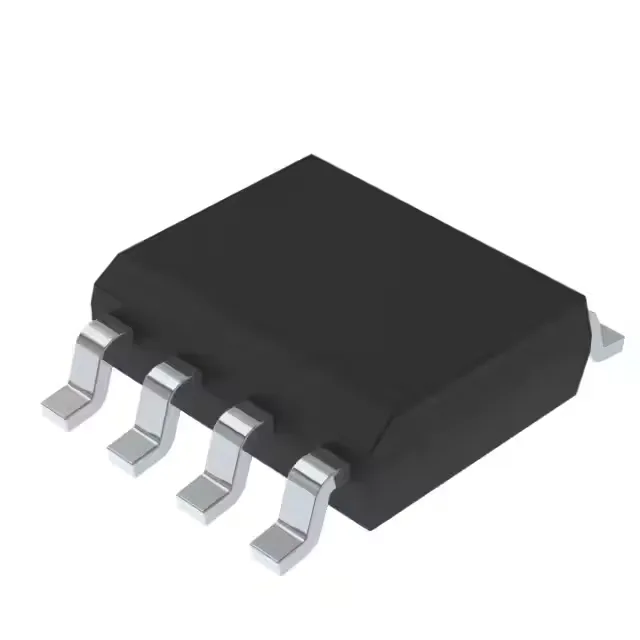
STMicroelectronics TS27L2IDT — Analog & Data Acquisition

STMicroelectronics TS27L2IDT CMOS Op-Amp, 100 kHz, 8-SOIC

MPNTS27L2IDT
End of Life

STMicroelectronics TS27L2IDT CMOS operational amplifier, dual channel, 100 kHz gain bandwidth, 0.04 V/µs slew rate, 10 µA supply per channel, 8-SOIC package, Tape & Reel.

$1.25Ref. price · indicative, final on quote
Packaging8-SOIC (0.154", 3.90mm Width)
RoHSROHS3 Compliant
Independent supplier — new & surplus stockAuthenticity-screened · ESD-safe packingListing updated Aug 2026

Specifications

TS27L2IDT specifications
ParameterValue
MountingSurface Mount
Amplifier typeCMOS
Voltage - input offset1.1 mV
Voltage - supply span16 V
Current - supply10µA (x2 Channels)
Current - input bias1 pA
Current - output (Channel)45 mA
Operating temperature-40°C ~ 125°C
Gain bandwidth product100 kHz
PackageTape & Reel (TR); Cut Tape (CT)
Slew rate0.04V/µs
Case8-SOIC (0.154\", 3.90mm Width)
Number of circuits2

Product details

100 kHz CMOS op-amp for low-frequency sensor conditioning

The STMicroelectronics TS27L2IDT is a dual-channel CMOS operational amplifier with a gain-bandwidth product of 100 kHz, making it suitable for conditioning signals from slow sensors like thermocouples, strain gauges, or photodiodes where the signal bandwidth stays well below the audio range. Each amplifier draws 10 µA of supply current, so the dual package consumes 20 µA total quiescent — this is the defining spec for battery-powered or energy-harvesting designs where every microamp counts.

The input offset voltage is 1.1 mV typical — for a 10 mV full-scale sensor signal this represents an 11% offset error that must be calibrated out in software or trimmed with a reference voltage at the non-inverting input.

Package and lifecycle for BOM planning

The part is ROHS3 compliant, so it meets the current restriction on hazardous substances for European and global markets.

Frequently asked questions

Will the TS27L2IDT drop into a board designed for the TS27L2BIDT?

Yes — both parts share the same 8-SOIC package, pinout, supply range, and 100 kHz gain-bandwidth. The TS27L2BIDT specifies a lower 250 µV input offset voltage versus 1.1 mV on the TS27L2IDT, so the TS27L2IDT may require software calibration or a trim circuit if the original design relied on the tighter offset.

What is the TS27L2IDT's slew rate and why does it matter?

The slew rate is 0.04 V/µs. This means the output voltage can change at most 40 mV per microsecond — for a 1 V peak output, the maximum undistorted sine wave frequency is about 6.4 kHz. Signals above that will show slew-induced distortion, so this op-amp is best for low-frequency sensor conditioning, not audio or fast control loops.