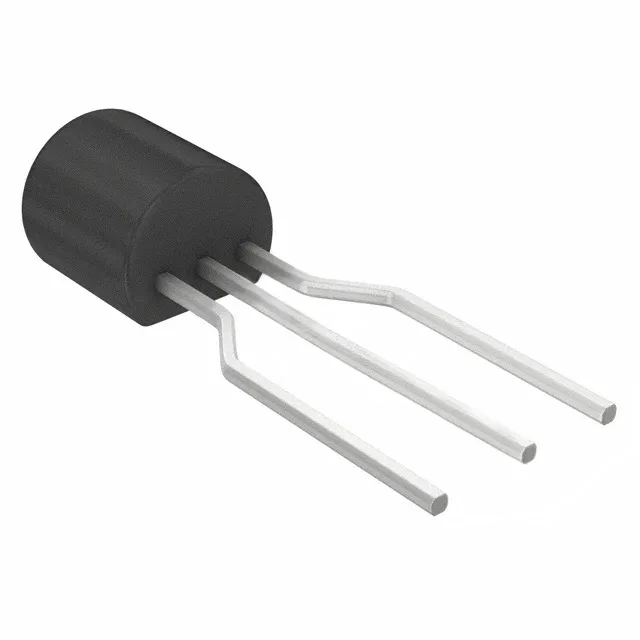
800 V sensitive-gate SCR in a TO-92
The STMicroelectronics TS110-8A2-AP is a sensitive-gate silicon controlled rectifier (SCR) rated for 800 V off-state blocking voltage and 1.25 A RMS on-state current. Packaged in a TO-92-3 through-hole format with formed leads, it targets low-power AC switching applications where a microcontroller or logic-level signal must directly trigger the gate without an intermediate driver transistor. This eliminates the driver transistor and base resistor from the BOM for small loads like relays, solenoids, indicator lamps, or fractional-horsepower motors.
On-state ratings and surge capability
With an average on-state current of 800 mA and RMS current of 1.25 A, the TS110-8A2-AP suits continuous loads up to about 150 W on a 120 VAC line or 300 W on 240 VAC, assuming adequate heatsinking through the TO-92 leads. The maximum on-state voltage drop is 1.6 V at peak current, which keeps conduction losses manageable for a through-hole part of this size. Surge current capability is specified at 20 A for a 50 Hz half-cycle and 21 A for 60 Hz — a 16x to 17x margin over the RMS rating. This handles inrush from incandescent lamps, capacitive loads, or motor start-up without external soft-start circuitry, as long as the surge duration stays within the half-cycle window. The maximum holding current is 12 mA, and off-state leakage is just 1 µA at rated voltage. The low holding current means the SCR stays latched through the zero-crossing of a lightly loaded AC waveform, reducing the risk of premature commutation with inductive loads.
The 125°C ceiling is the junction limit — derate the on-state current above 25°C per the datasheet's thermal derating curve, which is typical for a TO-92 package with no heatsink.
ROHS3 compliance is confirmed, which simplifies compliance declarations for EU-market equipment. For dual-sourcing resilience, the X00602MA 1AA2 is a functional peer with a 600 V off-state rating and the same sensitive-gate characteristic, though the lower blocking voltage may not suit 240 VAC line applications.