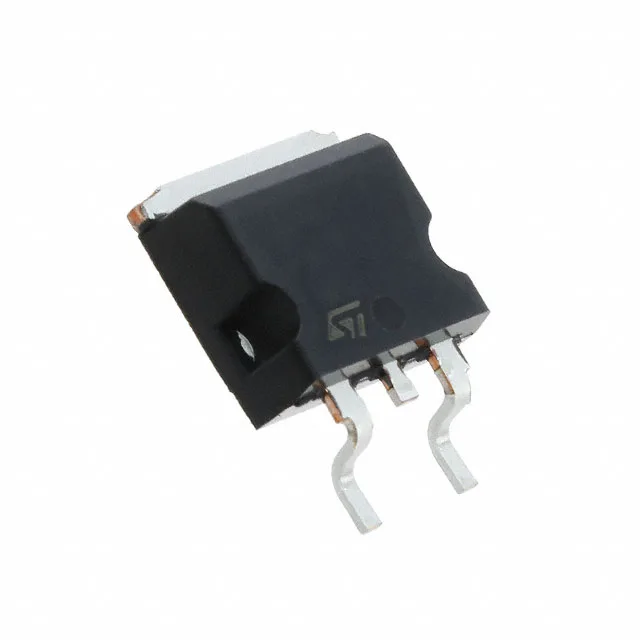
50 A RMS SCR in a surface-mount D²PAK — what you're getting
The STMicroelectronics TN5015H-6G is a standard-recovery SCR (silicon-controlled rectifier) in a D²PAK (TO-263) surface-mount package. It blocks 600 V off-state and conducts 50 A RMS (30 A average) on-state, with a non-repetitive surge rating of 493 A at 50 Hz. This is the part you pick when you need a medium-current thyristor for line-voltage phase control, soft-start, or AC-switching duties and you want to keep the assembly on a pick-and-place line — no through-hole leads to hand-solder.
600 V blocking, 150°C junction — where it lives comfortably
The 600 V off-state voltage gives you margin on a 230 VAC or 277 VAC line, covering the usual surge events without derating into the next voltage class. Off-state leakage is specified at 10 µA max, so you are not wasting standby power on a semi-conducting junction.
Gate drive numbers that matter for first-power
Gate trigger current is 15 mA max, gate trigger voltage 1.3 V max. That is a standard-threshold SCR — your microcontroller GPIO through a resistor-transistor driver will fire it, but do not expect a sensitive-gate part that turns on with a few hundred microamps. The holding current is 60 mA max, so once triggered, it stays latched until the load current drops below that level. If your load is a small solenoid or a relay coil that draws less than 60 mA steady-state, the SCR may not commutate off cleanly — factor that into the design.
Package and thermal: the D²PAK tab is your heatsink
This comes in the D²PAK (TO-263) surface-mount package, three leads plus the tab. The tab is the anode connection and the primary thermal path. At 50 A RMS you will need a copper-land area or an external heatsink on that tab — the package alone cannot dissipate the heat from full-rated current without a good thermal interface. The tube shipping medium is fine for prototyping; production volumes typically order on tape and reel.