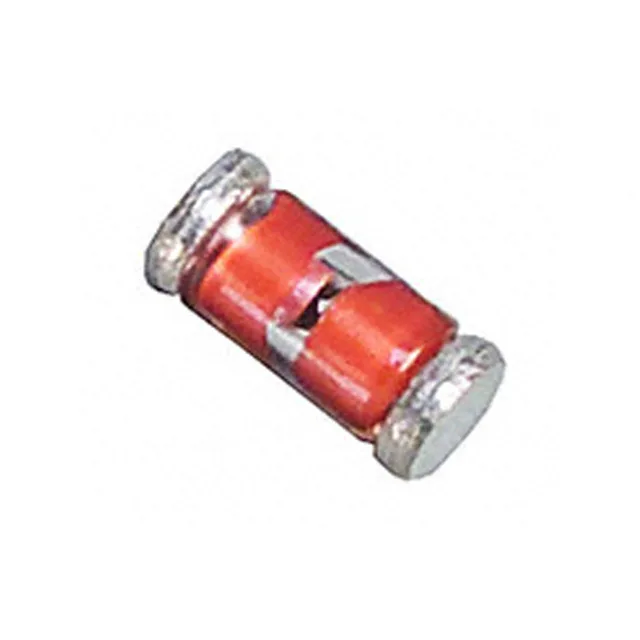
40 V, 350 mA Schottky in a glass Mini MELF
The STMicroelectronics TMMBAT48FILM is a 40 V, 350 mA Schottky barrier rectifier in a DO-213AA (Mini MELF) glass package. Its 10 ns reverse recovery time (trr) makes it suited for fast-switching low-voltage rails — think polarity protection, freewheeling, and high-frequency rectification in DC-DC converters or signal conditioning paths.
Forward drop and leakage at temperature
Maximum forward voltage is 750 mV at 200 mA forward current — the Schottky barrier keeps conduction losses lower than a pn-junction at this current level. Reverse leakage is 25 µA at the 40 V rated reverse voltage, but like all Schottkys, leakage climbs with junction temperature; the operating junction range is -65°C to 125°C, so the thermal budget at the top end needs a derating check against the actual reverse bias in circuit.
Package reality: DO-213AA Mini MELF
The DO-213AA is a glass-bodied, end-cap-terminated package — the metallised ends are the anode and cathode, no leads. The glass body is smaller than a SOD-123 but the end-cap geometry can be trickier for pick-and-place vision systems to centre. The 20 pF junction capacitance at 0 V, 1 MHz is low enough to keep switching losses minimal in sub-10 MHz applications.