55 ns trr — fast recovery for hard-switched power stages
The 55 ns reverse recovery time (trr) classifies this as a fast recovery diode (Speed: Fast Recovery =< 500 ns, > 200 mA). That trr figure is the key switching parameter: it determines the recovery losses in continuous-conduction-mode PFC boost stages, hard-switching flyback converters, and output rectification in 100–300 W SMPS designs. A 55 ns trr keeps the reverse-recovery charge low enough that the MOSFET or IGBT in the same leg does not see excessive turn-on stress at switching frequencies up to the 100 kHz range.
600 V / 8 A — continuous rating for PFC and DC-DC stages
Rated 600 V reverse voltage and 8 A average rectified current (Io). The 600 V blocking voltage covers universal-input PFC boost stages (nominal 380–400 VDC bus) with margin for line transients. The 8 A continuous rating suits boost, flyback, and two-switch forward converters in the 150–400 W output range. Forward voltage is 1.85 V max at 8 A — a typical conduction loss for an 8 A fast-recovery die in a D2PAK. Reverse leakage is 8 µA at 600 V, 25°C, which rises with junction temperature but stays within the thermal budget for most designs.
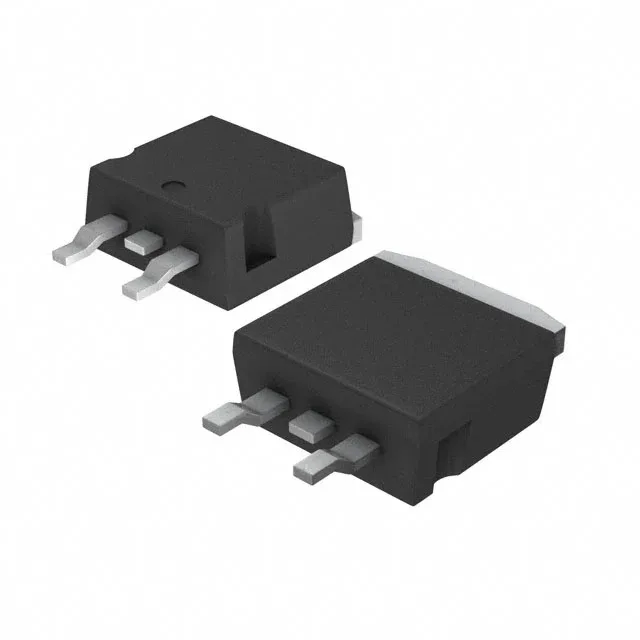
D2PAK (TO-263) — surface-mount power tab
Supplied in a D2PAK (TO-263-3, 2 leads plus tab) surface-mount package. For 8 A continuous, a minimum of 6–8 cm² of 2 oz copper on the tab side is typical to keep Tj below 125°C in still air.