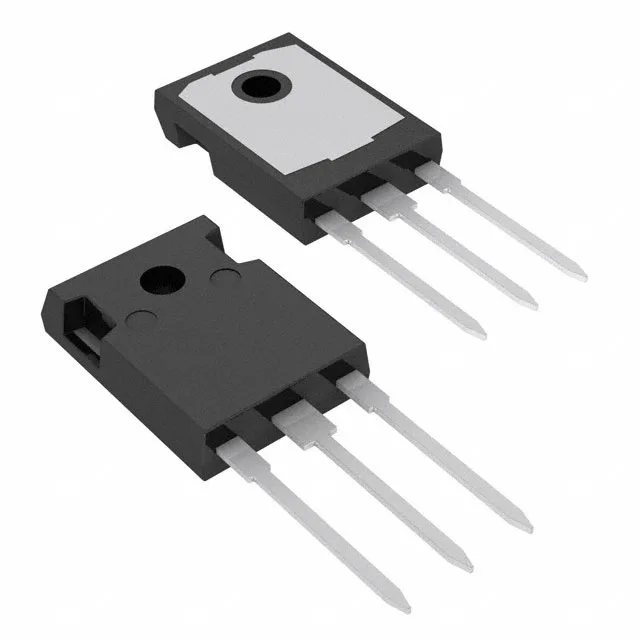
60 A total, 70 ns trr — the PFC and output rectifier choice
The STTH60AC06CWL is a dual fast-recovery epitaxial diode from STMicroelectronics, configured as a common-cathode pair in a single TO-247-3 package. The 70 ns trr is the headline number for a designer evaluating switching losses at line-frequency and moderate hard-switching stages. It is fast enough to keep recovery losses manageable in a 50-60 Hz rectifier bridge or a CCM PFC stage running at 50-100 kHz, without the cost premium of an ultrafast (< 35 ns) SiC or hyperfast diode.
Conduction loss and thermal budget at 30 A
At 30 A forward current, the maximum forward voltage is 1.75 V, which translates to 52.5 W conduction loss per diode at peak current. In a typical CCM PFC stage where each diode conducts for half the line cycle, the average loss is roughly half that figure, but the thermal design must still handle the peak. Reverse leakage is specified at 10 µA at 600 V and 25°C junction. Leakage doubles roughly every 10°C, so at 125°C junction it is in the low-mA range — negligible for efficiency but worth checking in a high-temperature soak test.
Package and mounting — the TO-247 common-cathode reality
The TO-247-3 package is a through-hole power package with a large copper tab. The common-cathode configuration means the tab is at the cathode potential — in a boost PFC that is the output rail (typically 400 VDC). The tab must be electrically isolated from the heatsink with a sil-pad or mica washer rated for 600 V working voltage, or the heatsink must be grounded and the diode mounted with an insulator. The through-hole leads handle the 30 A per leg without additional bus bars, but the PCB trace from the leads to the bulk capacitor must be sized for the RMS current — 0.5 mm per amp is a safe starting point for 2 oz copper.