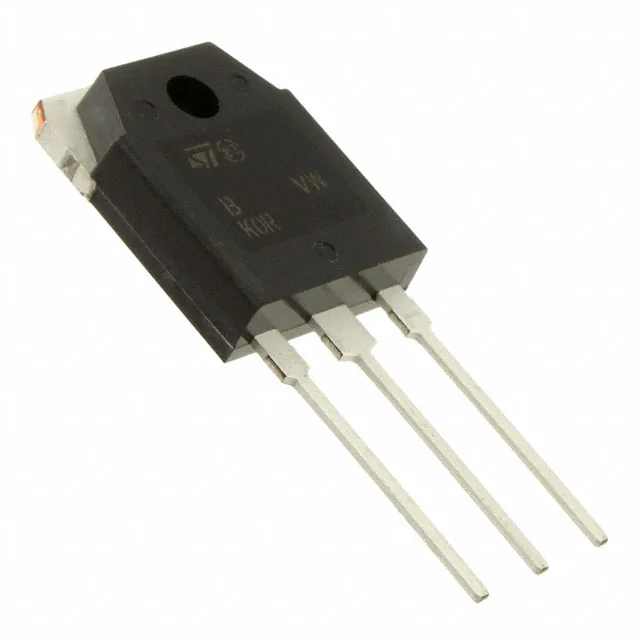
Typical applications include boost diodes in power-factor-correction stages, output rectifiers in switch-mode power supplies, and snubber or freewheeling diodes in motor drives and inverters where fast switching and low recovery losses are needed.
The 40 ns reverse recovery time places this diode in the fast-recovery class suitable for hard-switched topologies operating in the tens to low hundreds of kilohertz. In a continuous-conduction-mode PFC stage, the short trr reduces the turn-on loss in the MOSFET and keeps the reverse-recovery current spike within the EMI margin. The 1.75 V forward drop at 30 A is a conduction-loss trade-off typical of fast-recovery devices — expect higher Vf than an ultrafast or Schottky equivalent at the same current, but the 175°C junction rating gives thermal headroom for the extra dissipation.
If you are qualifying a replacement, the common-cathode TO-3P footprint and 600 V / 30 A per diode rating are the key parameters to match; several STMicroelectronics and competitor ultrafast diodes in the same package may be pin-compatible candidates, but verify the lead form and mechanical outline against the TO-3P-3 (SC-65-3) case.