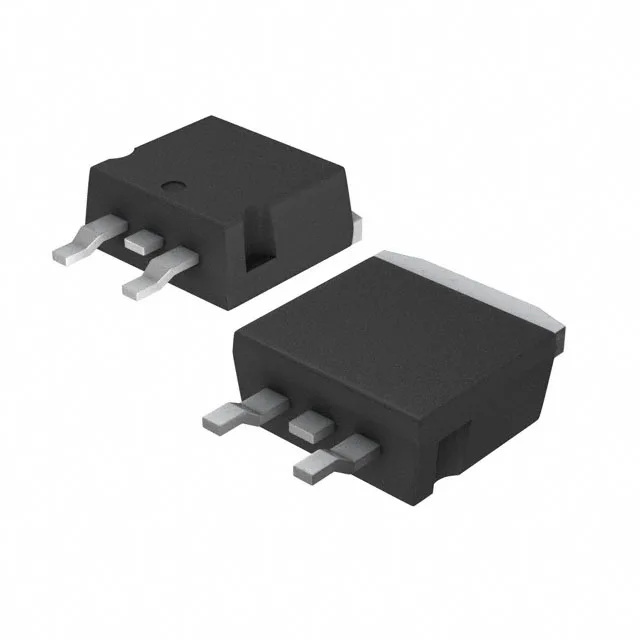
Fast recovery diode for hard-switched PFC and flyback stages
It is designed for continuous-current-mode power factor correction (CCM PFC) boost stages and flyback output rectification where the switching frequency pushes the recovery loss budget. The 40 ns trr keeps the reverse-recovery charge low enough that the MOSFET or IGBT does not see a current spike at turn-on, which is the failure mode in a 100 kHz PFC stage if you use a standard recovery diode.
The 40 ns reverse recovery time is the headline number for this diode. In a 100 kHz CCM PFC boost, the diode turns off into the rising MOSFET drain voltage; a slower recovery injects a reverse-recovery current spike that adds switching loss and can ring the gate drive. At 5 A forward current and 600 V blocking, the 40 ns trr keeps the recovery charge under a few tens of nC, which means the MOSFET sees a soft turn-on and the EMI filter does not have to suppress a high-frequency ring. The 2.9 V forward drop at 5 A is the conduction loss trade-off — expect about 14.5 W at full load, so the D2PAK tab needs a copper pour and airflow or a heatsink to keep the junction below 175 °C.
Obsolete — sourcing through the surplus channel
D2PAK footprint and thermal design
The diode comes in a TO-263-3 (D2PAK) surface-mount package. The junction is rated to 175 °C maximum, so the thermal resistance from junction to ambient depends on the board copper area and airflow. A 2 oz copper pour of at least 600 mm² under the tab keeps the junction temperature rise within bounds at 5 A continuous. The package ships in Tube form — if your pick-and-place line expects tape-and-reel, confirm the packing variant before ordering.