600 V, 3 A, 50 ns trr — what this diode does in the circuit
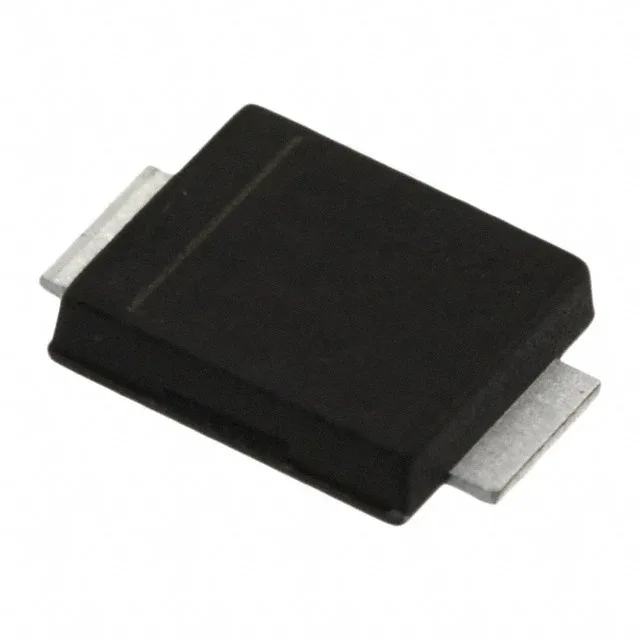
The STTH3R06UFY is an STMicroelectronics fast-recovery rectifier rated for 600 V reverse voltage and 3 A average forward current, with a 50 ns reverse recovery time. It is qualified to AEC-Q101 and comes in the low-profile SMB Flat Leads package (DO-221AA). This part is designed for the output rectification stage of a 400 V bus PFC, as a snubber clamp in a flyback converter, or as a boost diode in an automotive DC-DC converter where the junction temperature can hit 175°C.
50 ns trr — the switching-speed decision
A 50 ns reverse recovery time at 3 A is the spec that makes this diode useful in hard-switched topologies. In a continuous-conduction-mode PFC, the diode's stored charge during turn-off creates a current spike that hits the MOSFET — a slower recovery diode (200 ns or more) burns extra switching loss and risks EMI. The 50 ns trr keeps that spike manageable up to the 100 kHz range. If your design runs above 150 kHz, you would typically step to an SiC Schottky, but for the 50–100 kHz sweet spot this is the right recovery speed.
AEC-Q101 and 175°C junction — where it survives
The SMB Flat Leads package has a low thermal resistance to the board, but the via pattern under the pad still determines the real junction temperature at 3 A continuous.
1.9 V forward drop at 3 A — the conduction loss trade
The forward voltage is 1.9 V maximum at 3 A, which is typical for a 600 V fast-recovery diode in this current class. At 3 A that is 5.7 W conduction loss — the SMB Flat Leads package needs a decent copper area to spread that heat. If the board is space-constrained or the ambient is high, the designer may need to parallel two diodes or move to a DPAK part. The 3 µA reverse leakage at 600 V is low enough that it does not matter until the junction temperature passes 125°C, where leakage roughly doubles per 10°C.