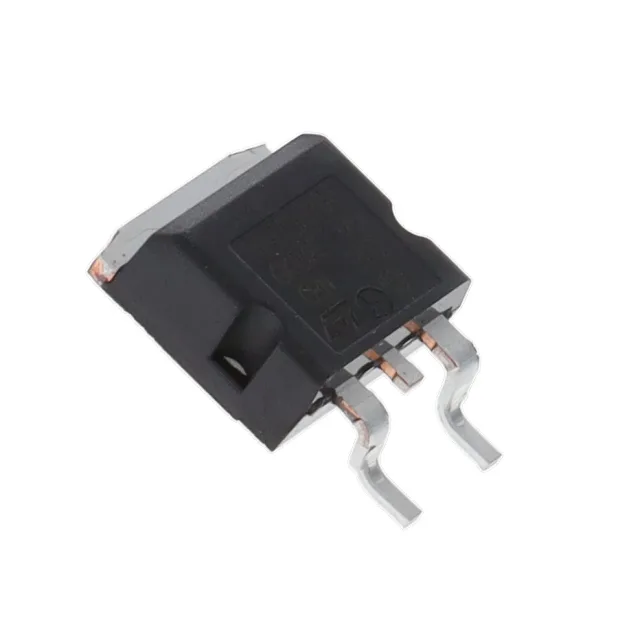
600 V, 30 A fast recovery diode — AEC-Q101 for automotive rectification
The 55 ns reverse recovery time places this diode in the fast-recovery class (≤ 500 ns at > 200 mA). In a hard-switched boost PFC or DC-DC converter, the trr directly sets the turn-off switching loss in the diode and the reverse-recovery current spike that the MOSFET must commutate. A 55 ns trr at 30 A keeps the recovery charge low enough that the diode does not dominate the switching loss budget in a 50–100 kHz converter, but the designer should still model the Qrr from the datasheet curve against the actual junction temperature — trr doubles as Tj approaches 175°C.
Automotive temperature grade and qualification
The 175°C Tj(max) allows the diode to operate in high-ambient engine-bay environments — alternator rectification, transmission oil-pump drives, or on-engine sensor supplies — without derating the 30 A forward current. The forward voltage drop is 2.95 V maximum at 30 A and 25°C; at 175°C Tj the Vf will be lower, but the leakage current at 600 V reverse bias rises to 40 µA at 25°C and increases exponentially with temperature — the thermal design must account for the leakage power at high Tj.
Package and mounting — D²PAK thermal considerations
The tab is the anode connection and the primary thermal path. For the 30 A rating to be usable in continuous conduction, the PCB must have a sufficient copper area on the drain pad — typically 2–4 square inches on a 2 oz copper board — to keep the junction below 175°C. The mounting type is surface mount; no through-hole equivalent exists in this package variant.
For dual-sourcing, a buyer would need to evaluate functionally equivalent fast-recovery diodes from other manufacturers at the same voltage, current, and trr class — no pin-compatible drop-in is documented.