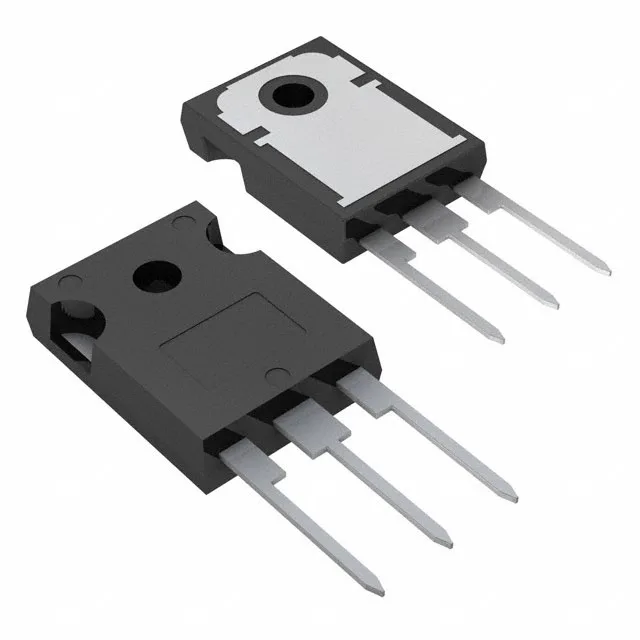
Dual fast-recovery diode for PFC and output rectification
Its 35 ns reverse recovery time places it in the fast-recovery class, making it suited for continuous-conduction-mode PFC boost stages, output rectification in SMPS, and freewheeling diodes in motor-drive inverters where switching losses dominate the thermal budget.
A 35 ns reverse recovery time at 15 A forward current means the diode clears stored charge quickly during turn-off, keeping the switching energy per cycle low. In a 100 kHz PFC stage, the recovery loss scales linearly with trr; a 35 ns part runs cooler than a 100 ns general-purpose rectifier at the same frequency, allowing a smaller heatsink or higher output power. The 1.9 V forward drop at 15 A and 25°C junction sets the conduction loss floor at roughly 28.5 W per diode at full rated current. Actual junction temperature will be higher than ambient, so the Vf increase with temperature must be factored into the heatsink design — the 175°C maximum junction rating provides headroom for that rise.
300 V reverse voltage and 175°C junction — thermal and voltage margin
The 300 V DC reverse rating covers the rectified bus from a 230 VAC line (nominal 325 V peak) with about 25 V of margin at nominal conditions. For 277 VAC or high-line transients, the margin narrows; a 400 V or 600 V rated diode would be the safer choice in those applications. A 175°C maximum junction temperature is 25°C higher than the common 150°C limit on standard fast-recovery diodes. That extra headroom lets the STTH30R03CW sustain higher average current or operate in a hotter enclosure without derating, which is useful in sealed power supplies or motor drives where airflow is limited.