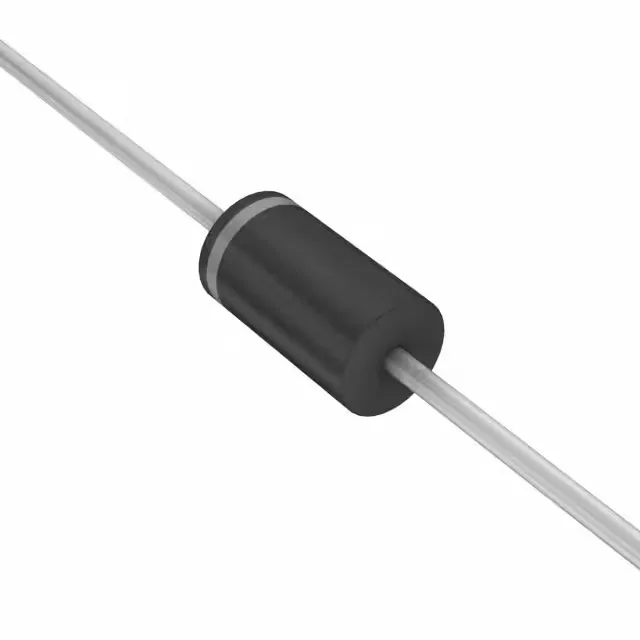
Active, fast, and field-swappable
The STTH302RL: The 950 mV forward drop at 3 A is the conduction loss figure you budget into the thermal calculation; at 3 A average, that is about 2.85 W of forward dissipation, which the DO-201AD body sheds through the lead wires into the PCB or terminal block.
What the 35 ns trr means for your switching node
A 35 ns trr means the diode sweeps out stored charge fast enough to keep the reverse-recovery current spike narrow in a 50-100 kHz boost or flyback converter. Compare that to a standard recovery diode in the same socket — the slower recovery would dump more charge back into the FET, raising the switching loss and the EMI floor. The 3 µA reverse leakage at 200 V rated voltage is a room-temperature figure; leakage doubles roughly every 10°C above 25°C, so at 125°C junction you are looking at around 50-100 µA. That is still low enough not to upset the bias in a snubber or clamp circuit, but it is worth a sanity check if the diode sits across a high-impedance node.
Package and board-fit — through-hole, no hot air needed
The DO-201AD axial package is a through-hole form factor — the leads go into plated through-holes on the PCB or into a terminal block. No hot-air station, no reflow profile; a soldering iron and a pair of cutters is all it takes to swap this on site. The tape-and-reel (TR) and cut-tape (CT) packaging options mean it ships in reels for automated insertion or as cut lengths for prototype and repair kits. The axial leads are tinned and ready for wave or hand solder.
Temperature grade and thermal headroom
Rated for a maximum junction temperature of 175°C, the STTH302RL has headroom above the usual 150°C industrial limit. That extra 25°C matters in a cramped power supply where the diode sits next to a hot transformer or in a high-ambient enclosure without forced air.