What the 30 A and 1200 V ratings mean for your power stage
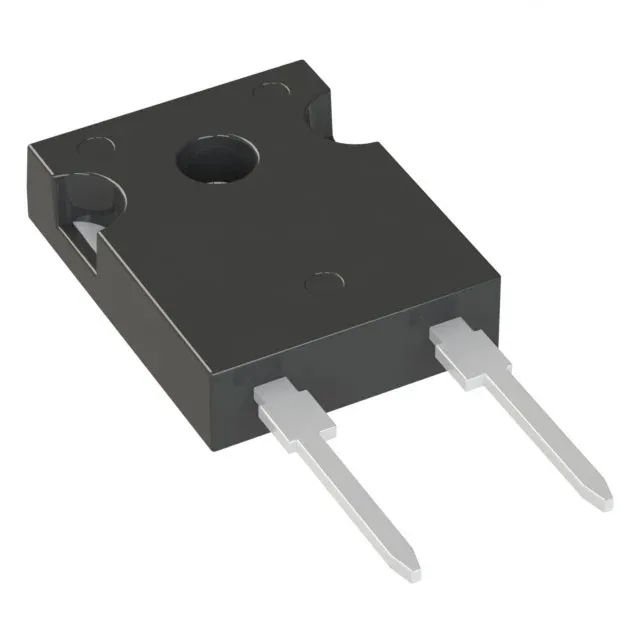
The STTH3012W is a 30 A average rectified, 1200 V reverse fast-recovery diode in a DO-247 through-hole package — the ratings that define where it fits in a power supply or motor drive output stage. 30 A continuous current at 1200 V means it handles the output rectification in a high-voltage bulk supply or the freewheeling path in a 3-phase inverter leg without needing to parallel devices, as long as the heatsinking keeps the junction below 175°C.
115 ns reverse recovery — the switching loss trade-off
The 115 ns reverse recovery time (trr) at 30 A puts it in the fast-recovery class — it snaps off fast enough to keep switching losses manageable in a 20-50 kHz hard-switched converter, but it is not an ultrafast diode. A 50-60 ns part would run cooler at higher frequency, but the STTH3012W's 2.25 V forward drop at 30 A is a direct conduction loss you can calculate: at 30 A that is 67.5 W instantaneous, so the thermal path to the heatsink has to be solid. Reverse leakage is 20 µA at the full 1200 V blocking voltage — negligible at room temperature, but it climbs exponentially with junction temperature. At 150°C junction the leakage can multiply by 10× or more, so the thermal design needs to keep the die below the 175°C absolute max even under fault conditions.
DO-247 package — what it demands from the board and heatsink
The DO-247 through-hole package with straight leads (DO-247-2 variant) is the same footprint as TO-247 but with a shorter body — it fits the standard 5.08 mm pitch hole pattern on a 2 oz copper board. The tab is the anode connection, so the heatsink pad needs electrical isolation unless the heatsink itself is at anode potential. Mounting torque on the tab screw matters — overtightening cracks the die; undertightening leaves an air gap that raises the thermal resistance. The typical M3 screw torque is 0.8-1.0 N·m with a flat washer and thermal compound. The junction-to-case thermal resistance is not listed here, but for a DO-247 it runs around 0.8-1.2°C/W — budget for it in the heatsink calculation.
Active production — no end-of-life concern for new builds
ROHS3 compliant per the lifecycle entry, so it meets the current EU restriction levels for lead, mercury, cadmium, and the four phthalates. No additional compliance documentation (REACH, UL, IEC) is recorded in the source data — confirm the specific certificate your QA team requires at RFQ time.