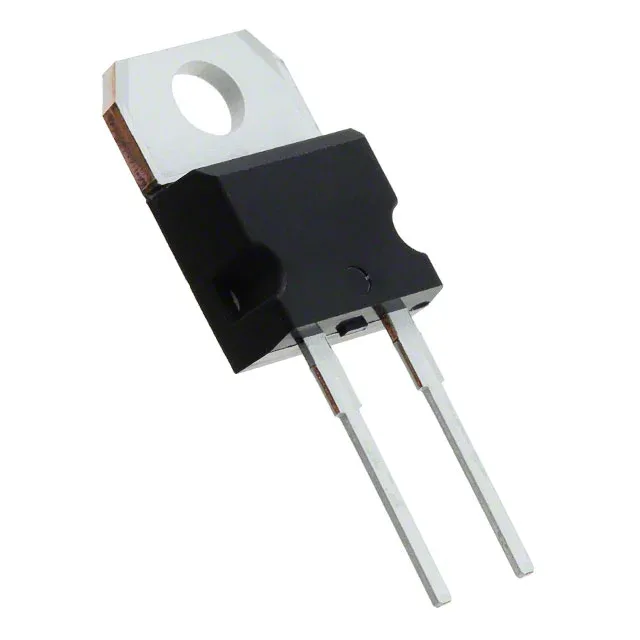
The STTH3012D is a 1200 V, 30 A fast recovery rectifier from STMicroelectronics in a TO-220-2 through-hole package. It is built for hard-switched power conversion where reverse recovery charge and switching losses drive the thermal design — PFC boost stages, high-voltage DC-DC converters, and inverter freewheel diodes in the 1–3 kW range. The 115 ns reverse recovery time (trr) is the key switching parameter: at 30 A and 1200 V bus, a slower diode would dump more recovery charge into the IGBT or MOSFET, raising junction temperature and risking shoot-through. This part keeps the recovery event short enough for 20–50 kHz hard-switched topologies without requiring a snubber on every transition.
Forward drop and conduction loss — heatsink sizing reality
At 30 A forward current the maximum forward voltage is 2.25 V, which means 67.5 W of conduction loss at full rated current. That is a lot of heat for a TO-220 tab — the junction-to-case thermal path must be kept short with a proper heatsink and thermal compound.
Reverse leakage at 1200 V — the blocking margin
Reverse leakage current is 20 µA at the full 1200 V reverse voltage. That is low enough that leakage-induced self-heating is negligible in most designs, but it rises exponentially with junction temperature — at 125°C junction the leakage can be several milliamps, which matters if the diode sits in a high-impedance circuit or a stacked-voltage string.
Package and assembly — TO-220-2 through-hole
The TO-220-2 package (supplier device package TO-220AC) is a two-lead through-hole power package with a metal tab. The tab is electrically connected to the cathode — it must be isolated from the heatsink or the heatsink must be grounded accordingly. Through-hole assembly is straightforward for wave solder or hand-solder rework, and the tab accepts a standard TO-220 clip or screw-mount heatsink.
The part is ROHS3 compliant. No official successor or second-source cross-reference is listed, so the BOM should be qualified with this single source unless a pin-compatible alternative is validated independently.