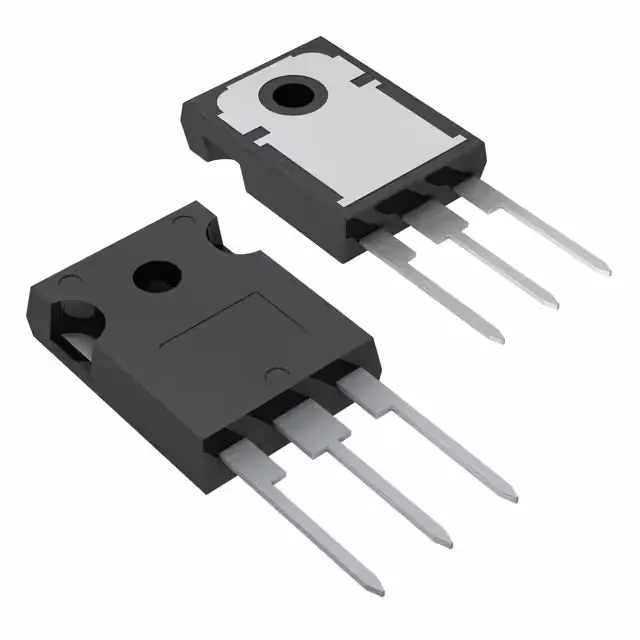
What the 40 ns trr buys you in a power stage
The headline number is the 40 ns reverse recovery time — that places it squarely in the ultrafast class, not the 200–500 ns recovery range the "Fast Recovery" label suggests. The TO-247-3 through-hole package handles the thermal load from the 1.25 V forward drop at 15 A, but you still need a good heatsink and airflow if both diodes run at full current simultaneously.
Common-cathode layout — one tab, one heatsink
The 1 Pair Common Cathode configuration means the two diode cathodes share the same die-attach pad, which is electrically the metal tab of the TO-247. That simplifies isolation: you bolt the whole package to a single grounded heatsink without an insulating pad between the diodes, as long as the heatsink itself is at the cathode potential. The two anodes are on separate pins, so the part works naturally as the high-side rectifier in a center-tapped full-wave secondary or as a pair of OR-ing diodes sharing a common output rail.
300 V rating — know the margin
The 300 V DC reverse voltage is the maximum repetitive peak. That covers 240 V AC rectified with a healthy derating margin, but it does not reach into 400 V DC-link territory. If your design runs from a power-factor-corrected 400 V bus, this is not the diode for the boost stage — you need a 600 V rated part. Where it fits: secondary-side rectification in a 100–240 V AC offline supply where the reflected voltage stays under 250 V, or in a 48 V input DC-DC converter where the voltage stress is well within the 300 V ceiling.
ST lists the STTH3003CW as Active.