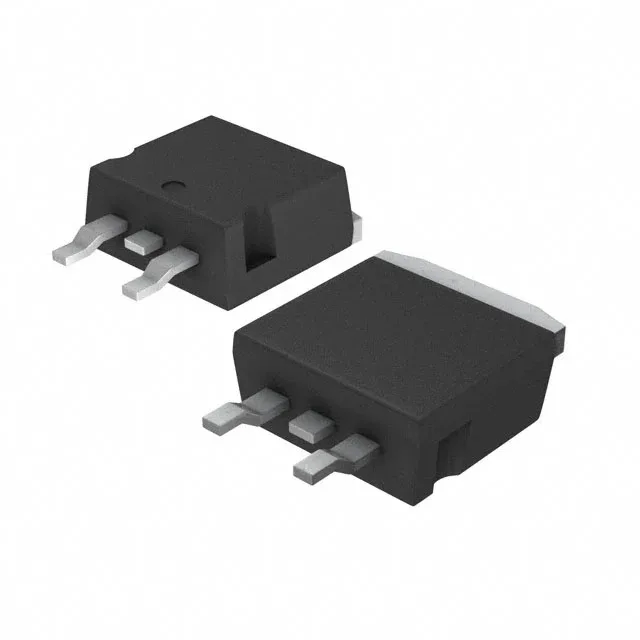
STMicroelectronics STTH20LCD06CG-TR — Discrete Semiconductors

STTH20LCD06CG-TR 600V 10A Fast Recovery Diode, 50ns trr

MPNSTTH20LCD06CG-TR
Obsolete

STMicroelectronics STTH20LCD06CG-TR, Fast Recovery Diode, 600V Vrrm, 10A per diode, 50ns trr, 1 Pair Common Cathode, D2PAK (TO-263AB), Tape & Reel.

$0.3207Ref. price · indicative, final on quote
Sourced new & surplus through independent channelsAuthenticity-screened · ESD-safe packingListing updated Jul 2026

Specifications

STTH20LCD06CG-TR specifications
ParameterValue
MountingSurface Mount
Voltage - DC reverse (Vr)600 V
Voltage - forward (Vf) (Max) @ if2 V @ 10 A
Current - reverse leakage @ vr1 µA @ 600 V
Current - average rectified (Io) (per diode)10A
Operating temperature - junction175°C (Max)
SpeedFast Recovery =< 500ns, > 200mA (Io)
PackageTape & Reel (TR)
TechnologyStandard
CaseTO-263-3, D2PAK (2 Leads + Tab), TO-263AB
Diode configuration1 Pair Common Cathode
Reverse recovery time50 ns

Product details

The STTH20LCD06CG-TR from STMicroelectronics is a 600 V, 10 A per diode fast-recovery rectifier in a common-cathode dual-diode configuration. The 50 ns reverse recovery time (trr) places it in the ultrafast class, suited for hard-switching topologies where reverse-recovery losses and EMI matter — boost PFC stages, output rectification in 400 V bus converters, and interleaved or center-tapped secondary windings.

ST lists the STTH20LCD06CG-TR as Obsolete. No last-time-buy window is open from the factory, and no direct successor is published in the lifecycle record. This part is not available through franchised distribution as a current-production line. Sourcing now runs through independent channels — brokers, excess inventory holders, and surplus stockists. The risk of counterfeit or relabeled parts rises when a device enters this phase, so traceability to a known date code and a trusted source is the main concern for a BOM line that still needs this exact order code.

50 ns trr — the switching-speed decision

At 50 ns trr, this diode recovers fast enough for continuous-conduction-mode (CCM) boost PFC at switching frequencies up to around 100 kHz without excessive reverse-recovery losses. The 2 V forward drop at 10 A is typical for a 600 V ultrafast — a trade-off: lower Vf would mean slower recovery, higher Vf would mean more conduction loss. For a 10 A average load per diode, the conduction loss runs about 20 W per die at full current, so the D2PAK's thermal pad and board copper are part of the thermal design, not an afterthought.

Common-cathode pair — topology fit

The 1 Pair Common Cathode configuration means the two anodes are separate and the cathodes are tied together internally. That matches center-tapped secondary rectifiers (cathode to the output, anodes to each winding end) and interleaved boost PFC where two inductors share a common output rail. It also saves board space versus two discrete SOD-123 or SMB devices — one D2PAK replaces two separate packages, which simplifies layout and reduces placement cost.

Frequently asked questions

What is the replacement for STTH20LCD06CG-TR?

For a pin-compatible replacement, look at the STTH20LCD06G (non-tape-and-reel variant) or the STTH20LCD06CG-TR's sibling STTH20LCD06G — same die, same ratings, different packing. For a functionally equivalent part from another brand, compare the 600 V, 10 A per diode, 50 ns trr, common-cathode D2PAK specification against offerings from ON Semiconductor (NRVTS series) or Vishay (HFA series). Verify the pinout and thermal pad before substituting.

What are the specifications of STTH20LCD06CG-TR diode?

600 V reverse voltage, 10 A average rectified current per diode, 50 ns reverse recovery time, 2 V forward drop at 10 A, 1 µA reverse leakage at 600 V, 175°C maximum junction temperature. Dual common-cathode pair in a D2PAK (TO-263AB) surface-mount package. Tape and Reel packing.

STTH20LCD06CG-TR vs STTH20LCD06G — what's the difference?

The only difference is the packing method. STTH20LCD06CG-TR ships in Tape & Reel (TR), while STTH20LCD06G ships in Tube or Bulk. The die, package, ratings, and pinout are identical. Choose the TR variant for automated pick-and-place assembly; choose the G variant for hand-assembly or low-volume builds.