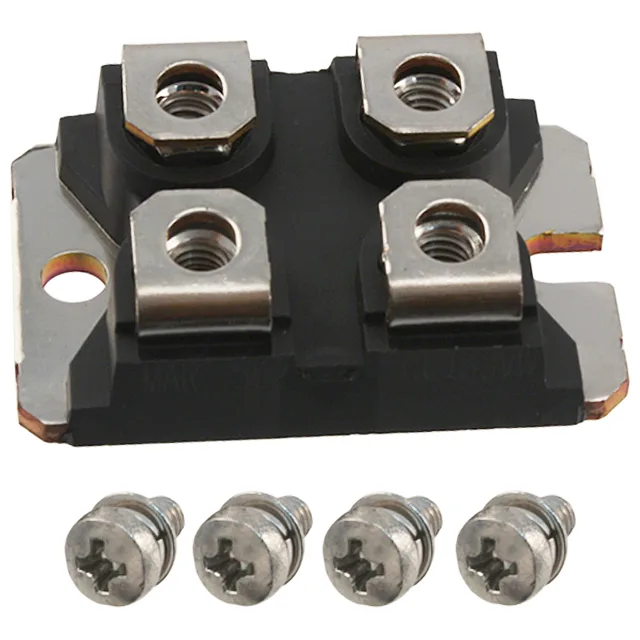
120A per leg, 400 V blocking — power rectifier in an ISOTOP baseplate package
The ISOTOP baseplate package bolts directly to a heatsink — the thermal path runs through the copper base, not PCB copper.
A 100 ns reverse recovery time at 120 A puts this diode in the fast-recovery class for industrial SMPS and motor-drive rectifier stages. At 20 kHz switching, the recovery charge per cycle stays manageable — the designer sizes the snubber across the diode, not across the IGBT or MOSFET. Going to 50 kHz pushes the recovery losses; a resonant or ZVS topology would want a trr under 50 ns. For a standard boost PFC or output rectifier at 20–30 kHz, the 100 ns trr is the right fit without paying for an ultrafast part the application does not need.
Dual-diode ISOTOP — one bolt-down package replaces two TO-247s
Two independent diodes in a single ISOTOP package share the same baseplate. For a center-tapped full-wave rectifier or an interleaved PFC stage, this cuts the number of bolt-down devices in half. The chassis-mount ISOTOP uses M4 or M5 screws through the mounting holes — the datasheet torque spec sets the thermal interface pressure. The package case is ISOTOP, supplier device package ISOTOP®; the large-area baseplate conducts heat directly into the heatsink, so the thermal design depends on the interface material and clamping force, not on PCB copper pour.
Sourcing — active production, quoted per BOM line
The base product number is STTH200; the TV1 suffix identifies the ISOTOP package variant.