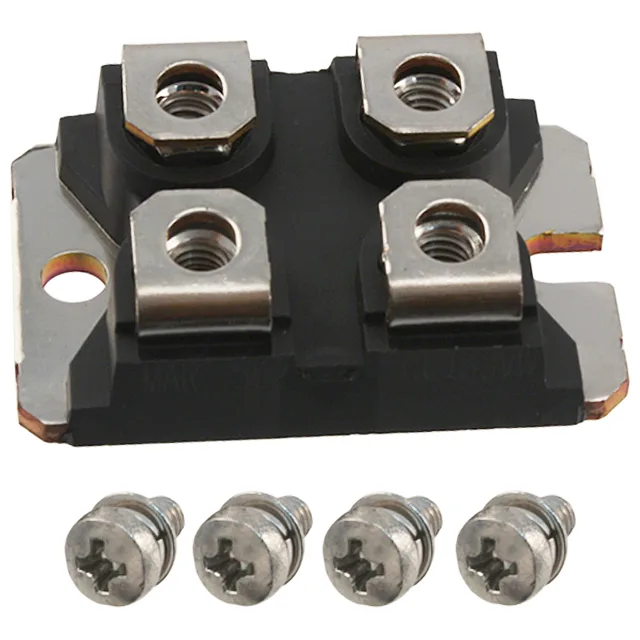
The STMicroelectronics STTH200F04TV1 is a 100A average-rated fast recovery epitaxial diode in the ISOTOP baseplate package, designed for chassis-mount power conversion. Its 80 ns reverse recovery time (trr) at 400 V reverse voltage puts it squarely in the high-frequency PFC boost, output rectification, and freewheeling diode role where a standard recovery part would burn through the switching budget. The 1.45 V forward drop at 100 A is the conduction loss number the thermal designer needs for the heatsink calculation. Junction temperature range covers -55°C to 150°C, which covers industrial and most automotive under-hood environments.
80 ns trr — why it matters for the switching frequency decision
The 80 ns reverse recovery time is the headline switching parameter. At 400 V bus voltage and 100 A switched current, each recovery event dissipates energy proportional to trr times the voltage. An 80 ns trr keeps the recovery loss manageable at 20–50 kHz switching frequencies typical of IGBT-based PFC stages. If the design pushes toward 100 kHz with SiC FETs, the recovery charge of a fast epitaxial diode like this still works, but the margin narrows — the buyer should confirm the total switching loss against the thermal budget at their actual frequency.
ISOTOP package — mounting and thermal interface
The ISOTOP (also known as SOT-227B) package is a four-screw chassis-mount module with an exposed metal baseplate. It is designed for bolting directly to a heatsink or cold plate with thermal compound or a phase-change pad. The package carries the 100 A average current without internal bond-wire bottlenecks, but the thermal resistance junction-to-case is the number that determines the real current derating — expect to keep the baseplate below 100°C to hold the 100 A rating. The four M4 screw holes are on a standard 38.2 mm x 25.4 mm pattern; verify the heatsink drill template matches before committing the mechanical layout.
The base product number STTH200 covers a family of voltage and speed variants in the same ISOTOP footprint, so if a future revision needs a higher voltage rating (e.g., 600 V) the mechanical layout and heatsink stay the same.