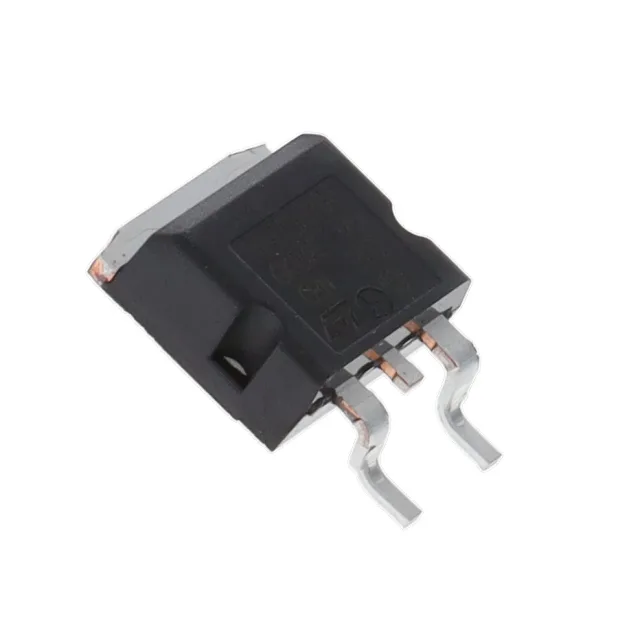
Automotive fast-recovery diode array for PFC and boost stages
The STTH16L06CGY-TR is an automotive-qualified (AEC-Q101) dual-diode array in a common-cathode configuration, rated for 600 V reverse voltage and 10 A average rectified current per diode. The 55 ns reverse recovery time (trr) makes it suited for continuous-conduction-mode (CCM) power-factor-correction (PFC) stages and high-frequency boost converters where switching losses dominate the thermal budget. The D2PAK (TO-263) surface-mount package with an exposed tab allows the designer to pull heat into the PCB copper plane — critical when the 2.08 V forward drop at 16 A pushes junction temperature toward the 175°C maximum.
Switching-loss budget and thermal derating
At 600 V blocking and 10 A forward, the 55 ns trr sets the turn-off energy per cycle. In a 100 kHz PFC stage, the recovery charge (Qrr) drawn from the datasheet's curve — not the trr alone — determines whether the diode or the MOSFET absorbs the crossover loss. The 8 µA reverse leakage at rated voltage doubles roughly every 10°C above 25°C, so the standby loss in a 125°C junction environment is non-negligible and should be factored into the heatsink calculation. The automotive temperature grade (-40°C to 175°C junction) covers the full under-hood range. AEC-Q101 qualification includes the additional stress tests (H3TRB, high-temperature reverse bias) that standard commercial parts skip — important for designs targeting PPAP or OEM validation.
Package and footprint compatibility
The D2PAK (TO-263-3) footprint is shared with the non-automotive sibling STTH16L06CG-TR, so a board laid out for the standard-grade part accepts the -GY variant without a layout change. The exposed tab is the cathode common terminal — the copper pour underneath must handle the full combined current of both diodes (up to 20 A total) and keep the tab temperature below 175°C. Supplied in tape-and-reel (Cut Tape also available), the package is compatible with standard reflow profiles for lead-free solder (260°C peak). ECOPACK®2 compliance means no halogens or antimony trioxide in the mold compound — a requirement for many automotive and industrial RoHS mandates.