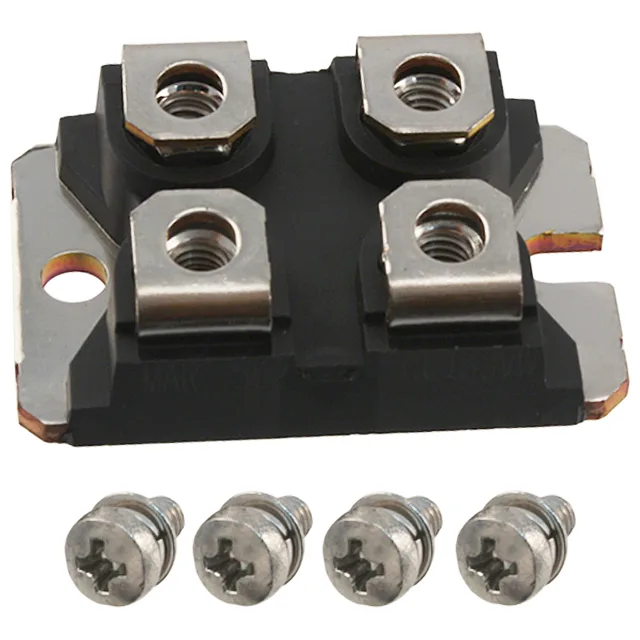
80 ns trr — fast enough for 100 kHz switching
Its 80 ns reverse recovery time (trr) puts it in the fast-recovery class (≤500 ns, >200 mA), making it a candidate for the output rectifier in a 100 kHz SMPS or the boost diode in a PFC stage where switching losses matter. Two independent diodes in the same ISOTOP package let you build a center-tap full-wave rectifier or a dual-output boost without a second device.
60 A per diode — thermal budget in an ISOTOP
At 60 A average per diode, the forward drop hits 1.2 V at 80 A (the max test point). That's about 72 W per diode at full rated current — the ISOTOP chassis-mount package is designed to bolt directly to a heatsink or chassis wall to pull that heat away. The junction is rated to 150°C max, so the thermal interface and airflow matter: a 0.5°C/W heatsink keeps the die below 125°C at 60 A continuous per diode in a 50°C ambient. Off-state leakage is 200 µA at 300 V — negligible for most designs, but worth a sanity check if the diode sits in a high-impedance node.
Active, but the ISOTOP footprint is the constraint
The ISOTOP package is a standard ST power-module footprint, so second-sourcing is straightforward if you ever need it. The base product number STTH16003 covers the family; the TV1 suffix denotes the ISOTOP variant.