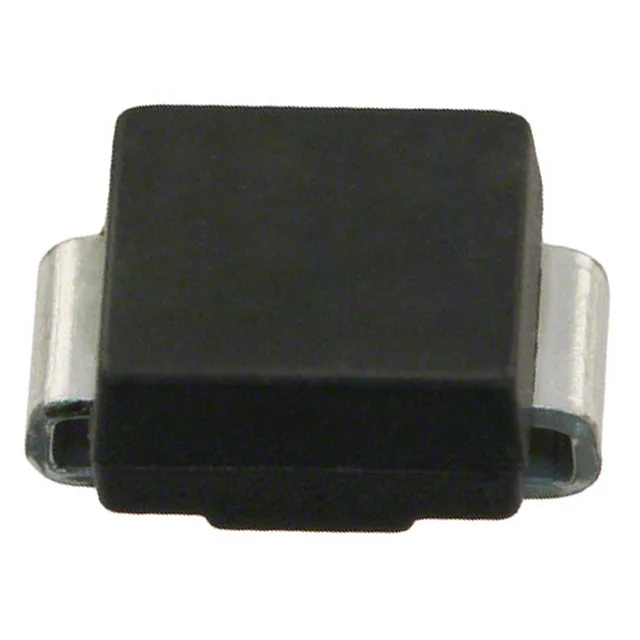
Active production, 1200 V blocking — why the STTH112U earns its place on a PFC or flyback secondary
The 75 ns reverse recovery time (trr) places it in the ultrafast class — fast enough for continuous-current-mode (CCM) PFC boost stages and flyback secondary rectification where the switching frequency sits in the 50–150 kHz range. The 175°C maximum junction temperature gives headroom in a cramped power supply where the diode shares a heatsink with a TO-220 MOSFET.
Forward drop and leakage — the thermal trade-off at 1200 V
Forward voltage is 1.9 V maximum at 1 A, 25°C. That is the conduction loss floor — at 1 A average the dissipation is 1.9 W before any temperature derating. The 5 µA reverse leakage at the full 1200 V rating is low for a 1200 V junction, but leakage doubles with temperature; at 125°C junction the leakage current can push the off-state dissipation above 100 mW, which matters in a no-load standby budget. The SMB footprint (DO-214AA) is a standard power diode package with a cathode tab that carries the heat into the PCB copper. The datasheet's thermal resistance assumes a minimum pad area — a board with a 1-inch² copper island under the tab keeps the junction below 125°C at 1 A continuous in still air.
How the STTH112U compares to its 800 V and 2 A siblings
The closest parametric peer is the STTH108A — same 1 A current, same 75 ns trr, same SMB package, but rated for 800 V instead of 1200 V. The STTH112U is the drop-in replacement when the DC bus exceeds 800 V, as in a 3-phase PFC output at 800 VDC or a flyback with a 1000 V reflected voltage. The STTH212U shares the 1200 V rating and the same trr but doubles the current to 2 A — it is the same die size in the same package, so the 2 A part runs cooler at 1 A but costs more.