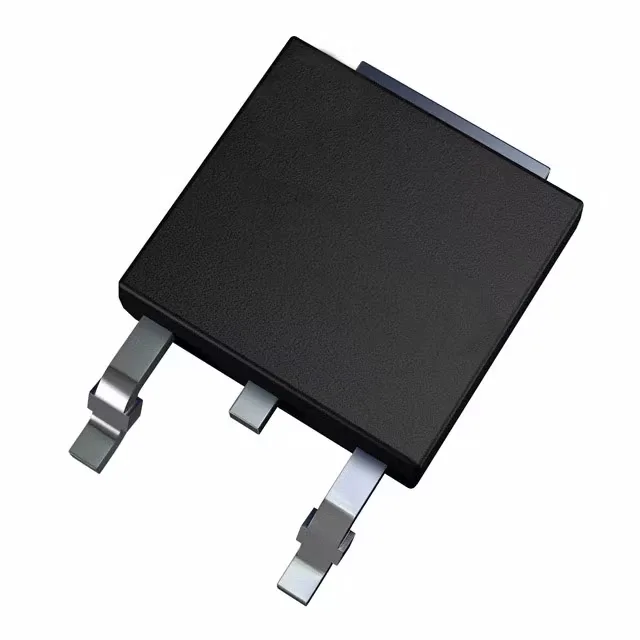
The STMicroelectronics STTH10LCD06SB-TR is a 10 A, 600 V ultrafast rectifier with a 50 ns reverse recovery time, housed in a DPAK (TO-252-3) surface-mount package. It is a standard diode type intended for high-frequency rectification in power conversion stages such as power-factor-correction boost circuits, flyback snubbers, and output rectification in offline switch-mode power supplies up to a few hundred watts. The 600 V blocking voltage suits it for universal-input AC/DC designs, while the 50 ns trr keeps switching losses low in continuous-current-mode topologies.
A 50 ns trr places this diode in the ultrafast class, well below the 500 ns threshold that defines fast recovery in the spec. In a PFC boost stage running at 65–100 kHz, that 50 ns recovery cuts the reverse-recovery charge and the associated turn-off loss compared to a slower 200 ns part. The trade-off is a forward voltage of 2 V at 10 A, which is higher than a standard recovery rectifier — you trade conduction loss for switching loss, which is the right call in hard-switched topologies where the diode's recovery dominates the dissipation.
10 A average current in a DPAK — thermal design matters
Rated for 10 A average rectified current at a 175 °C maximum junction temperature, the DPAK package needs a well-designed copper land on the PCB to pull heat out of the tab. At 10 A with a 2 V forward drop, the conduction loss alone is 20 W — that is a lot for a DPAK without a heatsink. In practice, the part is often run at lower average currents (3–5 A) in continuous boost stages, or used in discontinuous-mode flyback where the RMS current is lower. The 5 µA reverse leakage at 600 V is tight for a 175 °C rated junction, but expect it to multiply at high temperature.
The STTH10LCD06SB-TR is marked obsolete by STMicroelectronics. Each lot should be date-code traced and physically inspected — DPAK parts are sometimes re-marked or pulled from scrapped boards. The forward voltage and reverse recovery time should be bench-verified on a sample from any non-franchised source, particularly if the parts show inconsistent laser marking.