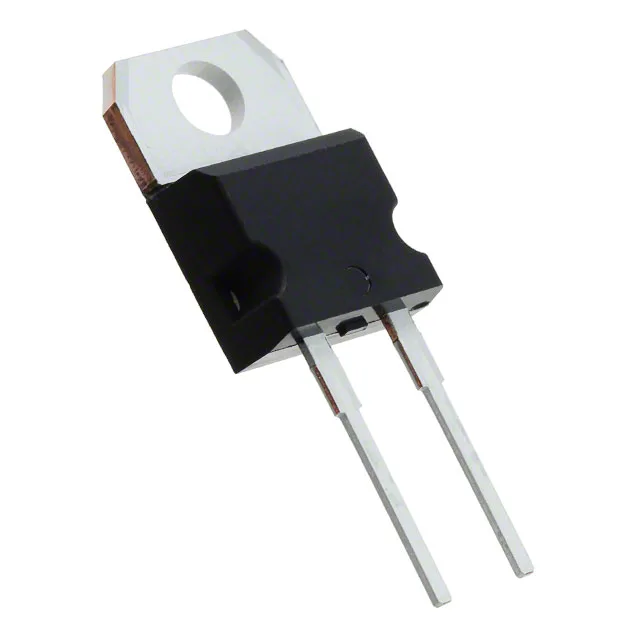
It houses two diodes in a series pair configuration inside a single TO-220AC through-hole package. The 55 ns reverse recovery time qualifies it for high-frequency switching applications where standard recovery diodes would cause excessive losses — think boost PFC stages, output rectification in 400 V bus converters, and snubber clamping in motor drives.
The 55 ns reverse recovery time is the headline switching spec. It allows the diode to turn off quickly when the current reverses, reducing the reverse-recovery charge that causes ringing and losses in a hard-switched converter. At 800 V blocking voltage, this diode suits 400 V DC bus rails with healthy derating margin — typical in three-phase industrial PFC stages or 350 V photovoltaic inverters. The 2.5 V forward drop at 10 A is higher than an ultrafast silicon diode of similar rating, but the series-pair configuration means the total forward drop across both diodes is 5 V at 10 A, which drives the heatsink design. The 20 µA leakage at 800 V is tight enough to keep standby losses low in a continuously biased snubber.
STMicroelectronics lists the STTH1008DTI as Obsolete. Buyers should expect to work with brokers or surplus stockists who can verify traceability to ST's original date codes. For a pin-compatible dual-diode replacement, the closest functional match is the STTH1008DTI itself through the surplus channel — no direct second-source cross-reference is published.