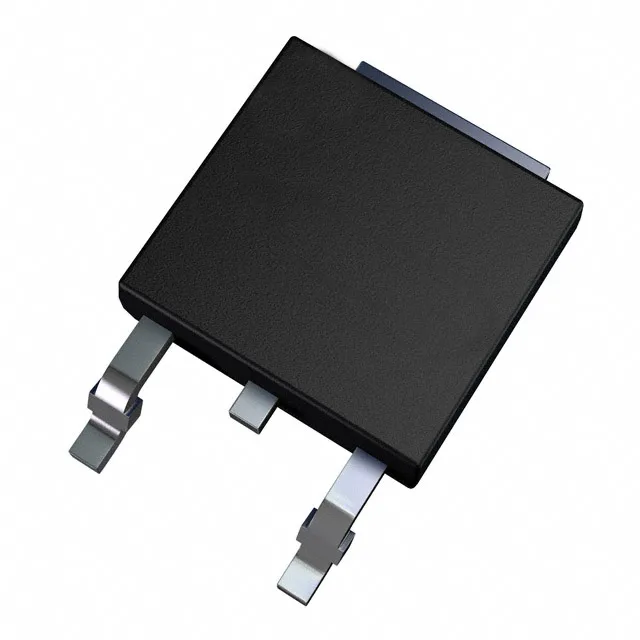
The STMicroelectronics STTH1002CBY-TR is an automotive-grade fast-recovery rectifier diode in a common-cathode pair configuration, housed in a DPAK (TO-252-3) surface-mount package.
The 25 ns trr is the key parameter for reducing switching losses in hard-switched topologies like boost PFC and flyback converters. A faster recovery means less overlap between voltage and current during turn-off, which directly lowers the dissipation in the diode and the companion MOSFET. It also shrinks the snubber requirements — the recovery charge is small enough that a simple RC snubber across the diode often suffices, saving board space and component count.
8 A per diode — thermal reality in the DPAK
Each diode in the common-cathode pair is rated for 8 A average rectified current. In a typical 12 V automotive alternator rectifier or a 48 V DC-DC output stage, that means the pair can handle up to 16 A total with proper thermal management. The DPAK package has an exposed tab on the drain side — the PCB copper area and via stitching under the tab determine the real-world current derating. At 175°C junction limit, expect to derate to roughly 60% of the 8 A if the ambient is 85°C and the copper area is minimal. The forward voltage drop of 1.1 V at 5 A is typical for a 200 V fast-recovery diode in this current class.
AEC-Q101 and the automotive BOM
The AEC-Q101 qualification is the automotive industry's stress-test standard for discrete semiconductors. It covers extended temperature cycling, high-temperature reverse bias, and humidity tests that commercial-grade parts skip. For a tier-1 supplier, using this part means no additional PPAP documentation or waiver request for the diode — it is already accepted in the supply chain. The active lifecycle status means ST is still manufacturing it, so no last-time-buy risk for ongoing production.