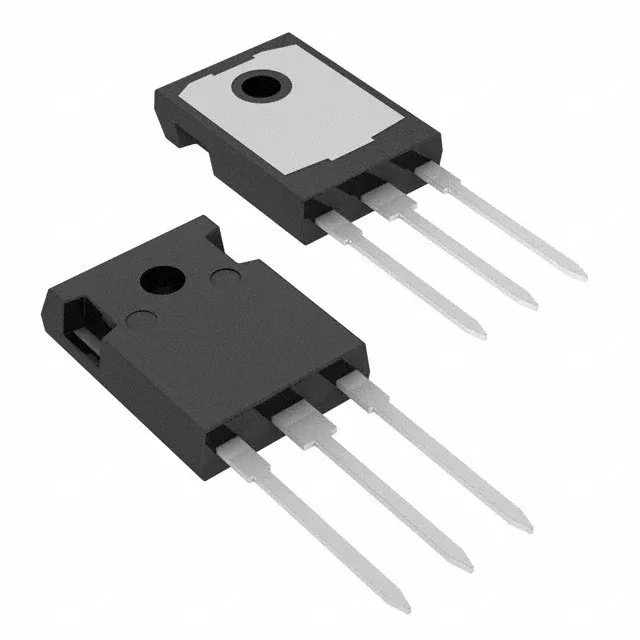
650 V blocking, zero-recovery switching — the SiC advantage
The STPSC20H065CWY: Silicon-carbide Schottky technology means zero reverse-recovery charge — the diode turns off with no stored minority carriers, so the switching loss in a hard-switched PFC or boost stage is dominated by the junction capacitance, not a recovery tail. At 650 V blocking, the reverse leakage is 100 µA typical at rated voltage, keeping standby losses low even at elevated junction temperature. Forward voltage is 1.75 V maximum at 10 A per diode — the conduction loss at full load is 17.5 W per die, which the TO-247-3 package sinks into the heatsink through the exposed backside tab. The 175 °C maximum junction temperature gives headroom in an under-hood or on-engine environment where ambient can hit 125 °C.
TO-247-3 common-cathode pinout — layout fit
The TO-247-3 package with common-cathode configuration means the centre pin is the cathode (shared), and the outer pins are the two anodes. In a continuous-conduction-mode PFC, this single package replaces two discrete TO-220 or D2PAK diodes with one through-hole device — the tab is the cathode, so the heatsink is at the same potential as the output rail, simplifying isolation design.
AEC-Q101 — what the grade certifies
AEC-Q101 qualification means this diode passed the automotive discrete stress tests: temperature cycling (-55 °C to 175 °C), high-temperature reverse bias (HTRB), and electrostatic discharge (HBM/MM) at the specified levels. The -40 °C to 175 °C junction range covers the full automotive temperature envelope — cold-crank at -40 °C and under-hood soak at 150 °C.
ROHS3 and ECOPACK®2 compliance
ROHS3 compliant and part of the ECOPACK®2 series — no restricted substances (lead, mercury, cadmium, hexavalent chromium, PBB, PBDE, and the four phthalates).