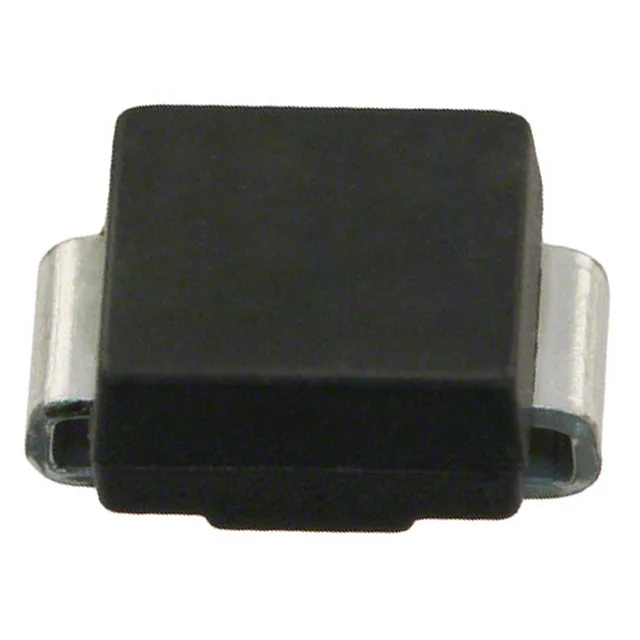
Package and footprint — SMB (DO-214AA)
The STPS3150U ships in the SMB (DO-214AA) surface-mount package, a compact footprint that fits standard reflow profiles. The cathode tab is the primary thermal path — the copper pad area under the tab on the PCB sets the junction-to-ambient thermal resistance, so the layout determines the real current capability at elevated ambient temperatures.
150 V, 3 A — the headline ratings and what they mean for the BOM
Rated 150 V DC reverse (Vr max) and 3 A average rectified current (Io). The 150 V blocking voltage gives margin on a 48 V or 72 V bus, and the 3 A average covers moderate-load rectification or freewheeling in a 1–2 A DC-DC converter output stage. Forward voltage is 820 mV maximum at 3 A — this is the conduction loss floor at full load. A Schottky's Vf drops with temperature, so the junction runs cooler at high current than a comparable PN diode, but the reverse leakage rises with temperature and can dominate the thermal budget above 125°C. Reverse leakage is 2 µA at 150 V reverse — a low figure that keeps standby dissipation negligible in a lightly loaded rail. Budget the leakage doubling every 10°C above 25°C; at 125°C junction it is roughly 64 µA, still acceptable for most power supplies.
175°C junction and switching speed
Maximum junction temperature is 175°C, a common Schottky ceiling that allows the die to run hot in a constrained thermal environment. The speed classification is Fast Recovery (≤500 ns, >200 mA Io) — this is a standard recovery Schottky, not an ultrafast type, so the reverse recovery charge is low but not zero; it suits 100–300 kHz switching frequencies in continuous-conduction-mode converters.